
How Old of a Boat Can You Finance? Age Limits Explained
How old of a boat can you finance? Most marine lenders will finance a boat that is 20 to 25 years old, as long as it has been well maintained and still holds enough market value to secure the loan. Specialized marine lenders sometimes go further, financing boats that are 25 to 30 years old or more, especially well-known fiberglass models from quality builders. The exact cutoff depends on the lender, the boat’s condition, and your down payment. Age is only part of the story: see whether a new or used boat is easier to finance before you decide.
How Old of a Boat Can You Finance? Age Limits by Lender Type
Not every lender draws the line in the same place. Here is how the main lender types typically handle older boats.
National banks and large lenders set the strictest limits, often capping financing at boats that are 15 to 20 years old. They see older boats as riskier collateral because boats lose value faster than houses, and an aging hull is more likely to need expensive repairs. When a boat’s market value drops below the remaining loan balance, the lender ends up with a loan backed by too little value, so most banks avoid that risk.
Credit unions are usually more flexible. Many will finance boats up to 20 or 25 years old, especially for members with strong credit. A few credit unions, though, cap boat age at 10 years, so policies vary widely. Always ask before you apply.
Specialized marine lenders are the most accommodating. They understand resale values and construction quality, so they often finance boats up to 25 years old and sometimes past 30 for well-kept fiberglass boats from respected brands. Good Sam, for example, finances standard boats up to 20 model years old, with older boats considered by phone.
Why Lenders Set Age Cutoffs
A boat loan is secured by the boat itself. If you stop paying, the lender repossesses the vessel and sells it to recover the debt. That backup plan only works if the boat is still worth something, and value is where age matters most.
Boats shed value steadily as systems wear out, and an older boat may need an engine rebuild, new electronics, or hull repairs that cost more than the boat is worth. To see how value fades over time, read our boat depreciation guide. Boat age cutoffs are their way of keeping that risk in check.
How Boat Age Affects Your Rate, Term, and Down Payment
Even when a lender says yes to an older boat, the terms are usually tougher than what a new boat would get.
Interest rates run higher on used boats. As a recent example, one major credit union advertised used-boat rates starting about half a percentage point above its new-boat rates for the same term length. The gap widens with older boats and weaker credit.
Loan terms shrink. New boats can qualify for 15 to 20 year terms at some lenders, but an older vessel is often limited to 10 to 15 years, and sometimes as little as five. Lenders want the loan paid off while the boat still has meaningful value left. Shorter terms plus higher rates mean the monthly payment on a 20-year-old boat can be surprisingly close to the payment on a newer, more expensive boat. Run both scenarios through a used boat loan calculator to see the real difference.
Down payments grow with age. Many lenders ask for 10 percent down on a new boat but 15 to 20 percent on a used boat over 10 years old. Past the 20-year mark, lenders often cap the loan at 60 to 70 percent of the boat’s value, which means you cover 30 to 40 percent out of pocket. A bigger down payment also protects you from owing more than the boat is worth.
What Improves Your Approval Odds on an Older Boat
Age is only the starting point. Lenders weigh several factors that can stretch or tighten the financing window.
Credit score matters more on older boats. Most marine lenders look for a minimum score around 680, though some will consider scores as low as 600 at higher rates. On an older boat, where the lender is already taking depreciation risk, a score above 700 plus a low debt-to-income ratio can sometimes persuade an underwriter to bend the standard age cutoff.
Condition and documentation. A complete maintenance file, engine-hour logs, and receipts for upgrades signal careful ownership.
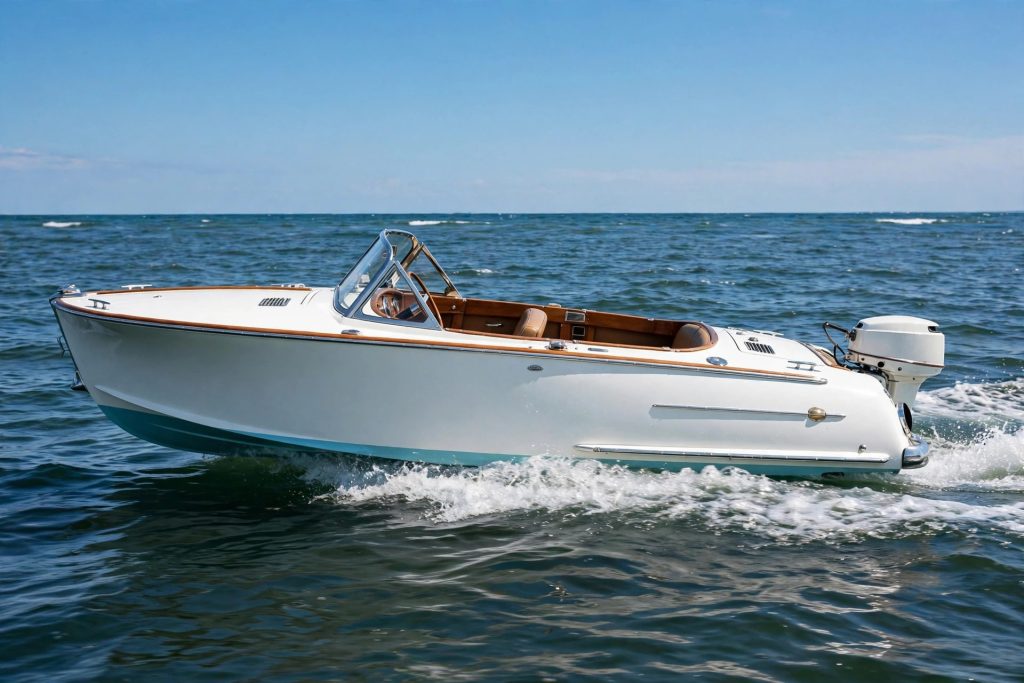
Hull and brand. Fiberglass hulls are viewed most favorably because they resist rot and structural breakdown. Well-known builders whose boats hold resale value give lenders a steadier asset to secure the loan against.
The Marine Survey: Required Homework for Older Boats
Before a lender funds a loan on an older boat, it will almost always require a pre-purchase Condition and Valuation survey from a certified marine surveyor. The surveyor inspects the hull, deck, engine, and systems, checks for water intrusion, rot, and delamination, and assigns a fair market value that the lender uses to size the loan.
Most lenders and insurers want the surveyor to be credentialed by the Society of Accredited Marine Surveyors (SAMS) or the National Association of Marine Surveyors (NAMS). Survey costs typically run $15 to $30 per foot of hull length, plus roughly $500 per engine if a separate engine survey is needed. You pay for the survey, so budget for it before you apply. Our boat survey guide explains what the surveyor checks and how to prepare.

If the survey turns up major problems, such as structural hull damage or a failing engine, the lender will usually require repairs before it releases funds.
Alternatives When the Boat Is Too Old to Finance
Some boats are simply past the point where any marine lender will take them, usually beyond 25 to 30 years with too little value left to secure a loan. You still have options.
Unsecured personal loans. The boat’s age does not matter because the loan is not secured by the boat. The tradeoff is higher rates, often well above 10 percent, shorter terms of two to seven years, and lower maximum loan amounts.
Home equity loans or HELOCs. If you own a home with enough equity, you can borrow against it at rates that are usually much lower than a personal loan. The risk is real: your home secures the debt, not the boat.
Seller financing. Some private sellers, especially those selling older classic boats, will carry a note directly. Terms are negotiable, but you lose some of the consumer protections that come with an institutional lender.
Start with a pre-approved boat loan so you know exactly where your lender draws the age line before you fall for a boat you cannot finance.
If you are buying in the UK, marine mortgage lenders apply similar age and survey rules to the US market. Estimate your payments with our marine mortgage calculator before you start viewing boats.
The Bottom Line
For most buyers, 20 to 25 years is the practical ceiling at a mainstream lender, with 30 years reachable through a marine specialist for a well-maintained boat. Beyond that, personal loans, home equity, or seller financing take over. Get the survey, put more down than the minimum, and run the numbers before you sign.

Michael Carter is a financial research writer specializing in vehicle financing, loan calculations, interest rates, and consumer budgeting. He creates practical, easy-to-understand resources that help readers make more informed financing decisions.