Boat Loan Interest Rates in 2026: What Lenders Are Actually Charging
Boat Loan Interest Rates in 2026: What Lenders Are Actually Charging
Boat loan interest rates catch most buyers off guard the second they see a real quote. You ran a few numbers in your head, maybe checked a calculator online, and landed on a figure that felt reasonable. Then a lender sends back something two or three points higher.
This happens because marine lending doesn’t work like auto financing, even though most buyers assume it does. A boat is classified as recreational collateral, depreciates faster than a car, and carries higher repossession costs for the lender. Your $60,000 boat loan quote at 9.2% isn’t a mistake. It’s the math working exactly as the lender designed it.
Here’s what this article gives you: the real rate ranges by credit tier in 2026, the exact factors pushing your number up or down, and a simple way to calculate what your true monthly cost will be before you sign anything.
Why Are Boat Loan Interest Rates Higher Than Car Loan Rates?
Lenders price risk, not friendship. A car holds resale value reasonably well and gets repossessed in days if you default. A boat sits in storage for months before a lender finds a buyer, and storage costs eat into their recovery.
That gap shows up directly in your rate. Boat loan interest rates in 2026 typically run 1.5 to 3 percentage points above comparable auto loan rates for the same credit profile. A borrower with a 740 credit score might see 6.5% on a car loan and 8.5% to 9% on a marine loan for an identical loan amount and term.
Loan term length makes this worse, not better. Marine lenders often stretch terms to 15 or 20 years to keep payments low, which sounds helpful until you calculate total interest paid over that stretch.
What Credit Score Actually Gets You the Best Boat Loan Rate?
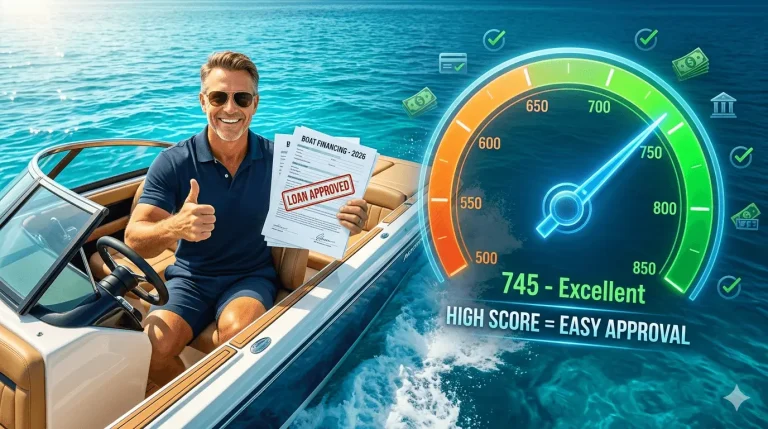
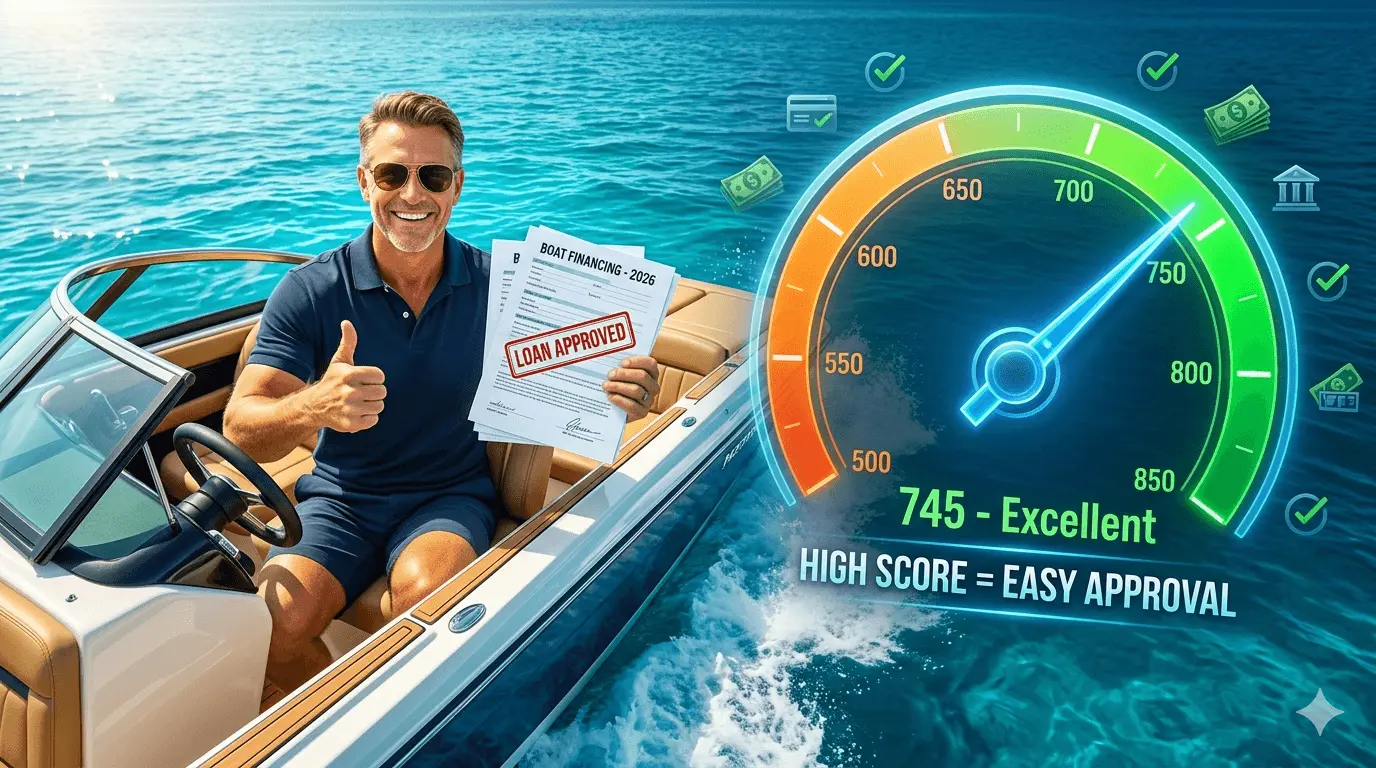
Your credit score does more work here than almost any other factor. Lenders split borrowers into tiers, and the jump between tiers is steep.
Borrowers above 760 typically see rates between 6.9% and 7.8% in 2026. Drop to the 680-719 range and you’re looking at 8.5% to 10.2%. Below 660, several major marine lenders won’t even quote you you’ll need a specialty lender charging 11% or higher.
Does Your Down Payment Change the Rate Itself?
Not directly, but it changes your loan-to-value ratio, which lenders do price into the rate. Put down 20% instead of 10% on a $45,000 boat and you’ll often shave a quarter to half a point off your quote, because the lender’s exposure drops with every dollar you put down upfront.
How Do You Find the Actual Lowest Boat Loan Rate Available to You?
Stop accepting the first quote your dealer hands you. Dealers mark up financing because they earn a kickback from the lender, sometimes adding a full point to your rate without telling you directly.
Call three sources in the same week: a marine-specialty lender like Trident Funding, your existing bank, and a credit union you qualify for through employment or membership. Credit unions frequently beat bank rates by half a point because they’re not-for-profit and pass savings to members.
Get every quote as an APR, not a monthly payment number. A salesperson quoting “just $340 a month” can hide a 10.5% rate behind a stretched 20-year term. The APR strips that trick away and gives you the real comparison.
Run the math yourself before signing. Multiply your loan amount by the rate, divide by 12, and compare that to what the lender quoted as interest-only cost for month one. If their number doesn’t match yours within a few dollars, ask why.
What Does Your Real Monthly Cost Look Like at These Rates?
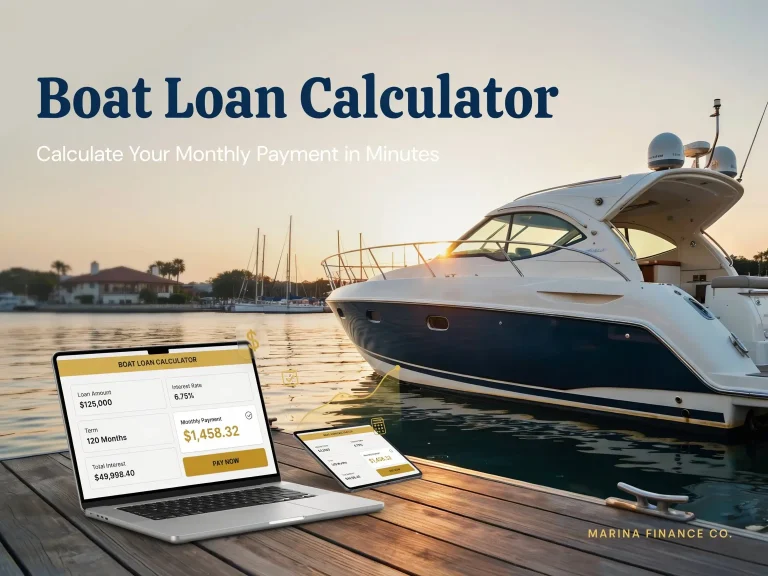
Take a $40,000 loan over 10 years. At 7% you’re paying roughly $465 a month and $15,800 in total interest. At 9%, the same loan jumps to about $507 a month and $20,840 in total interest a $5,000 difference for a two-point rate gap.
Stretch that same loan to 15 years and your monthly payment drops to around $360, but your total interest climbs past $24,000. Lower payments often mean you’re paying significantly more for the boat over time, not less.
This is the calculation dealers rarely walk you through, because a lower monthly number closes the sale faster than an honest total-cost comparison does.
Boat loan interest rates in 2026 depend heavily on your credit tier, your down payment, and whether you shop multiple lenders instead of accepting the first offer. The gap between a 7% and a 9% rate can cost you thousands over the life of the loan, even when the monthly payment looks similar on paper. Run your own numbers using the APR, compare at least three real quotes, and you’ll walk into your purchase knowing exactly what you’re paying for and why.