Boat Title Transfer: How to Transfer Ownership
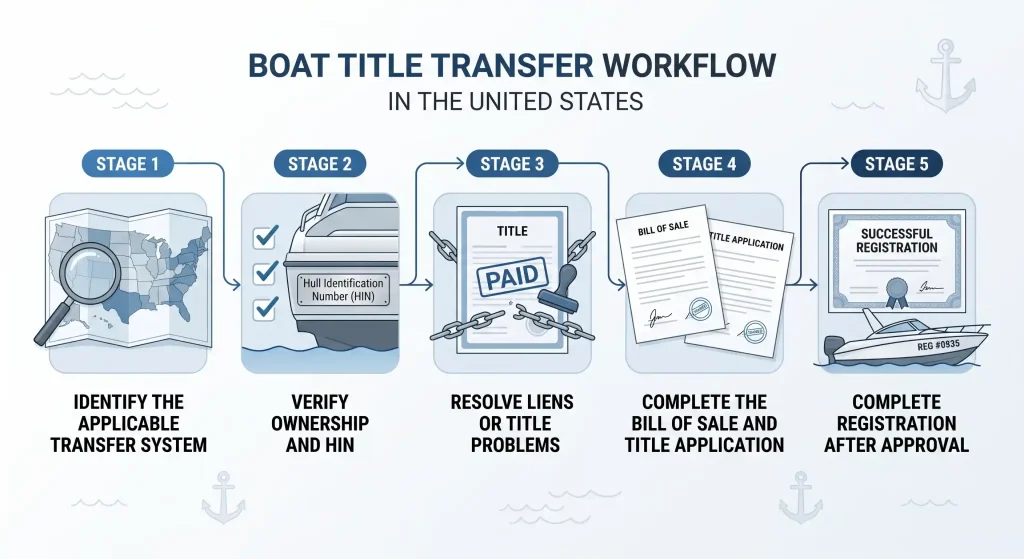
A boat title transfer records a change in ownership from the seller to the buyer. Before signing anything, first determine which ownership process applies to the boat, then verify the title, Hull Identification Number (HIN), seller, and any lien. After that, complete the required sale and title documents, submit them to the correct agency, pay applicable taxes and fees, and complete registration if required.
The exact process varies by state, so there is no single U.S. checklist that applies everywhere. Some boats may be titled by a state, while federally documented vessels follow a separate U.S. Coast Guard process. The safest approach is to identify → verify → transfer → resolve exceptions → register.
What Is a Boat Title Transfer?
A boat title transfer changes the recorded ownership of a titled boat. The title establishes the ownership record, while a bill of sale documents the transaction between the buyer and seller. Registration is a separate requirement governed by the applicable state or jurisdiction.
State requirements differ. Pennsylvania, for example, accepts a properly signed title for a previously titled boat, while other situations can require an out-of-state title or registration and a bill of sale.
Which Boat Ownership Transfer Process Applies to You?
Before starting the paperwork, identify which situation describes your boat:
| Situation | Transfer path |
|---|---|
| State-titled boat | Follow the title-transfer process of the applicable state |
| Registration-only boat | Follow the state’s ownership and registration requirements |
| Out-of-state boat | Verify what the receiving state accepts from the previous state |
| Federally documented vessel | Follow the U.S. Coast Guard documentation process |
Not every boat uses the same ownership-transfer process. Depending on the state and vessel, the transaction may involve a state title, registration record, or U.S. Coast Guard documentation.
For a federally documented vessel, ownership changes are handled through the U.S. Coast Guard’s National Vessel Documentation Center (NVDC). The NVDC identifies an ownership change as an exchange to the Certificate of Documentation.
What Documents Do You Need to Transfer a Boat Title?
The exact boat title transfer documents vary by state, but the transaction may require:
- Original boat title, properly assigned
- Bill of sale
- Hull Identification Number (HIN)
- Buyer and seller information
- Title application
- Registration documents, where applicable
- Lien release or other lien documentation
- Proof of applicable taxes and fees
- Out-of-state title or registration
- Additional ownership documents for unusual situations
The boat bill of sale should contain the information required by the applicable jurisdiction. For example, Texas requires the sale date, sales price, vessel and outboard information, purchaser names, and seller signatures.
If you need a transaction document, use the site’s boat bill of sale template rather than treating the title itself as the entire sales record.
Before You Transfer a Boat Title: Verify These 5 Things
Do these checks before completing the purchase, not after a title problem appears.
1. Verify the Seller’s Ownership
Check that the seller is the person or entity shown on the current ownership record and that the supporting documents connect the seller to the boat. If names or ownership records do not line up, resolve the discrepancy before completing the purchase.
2. Match the HIN to the Boat
Compare the Hull Identification Number (HIN) on the boat with the title and other ownership documents. A discrepancy can require additional verification before the transfer can proceed.
A pre-purchase boat inspection checklist can help you verify the HIN and other ownership-related information before completing the purchase.
3. Check for a Lien
Find out whether a lender or other lienholder has an interest in the boat. If a lien exists, determine what lien release, satisfaction, or other documentation is required.
4. Check the Title Assignment
Make sure the seller completes the required assignment fields accurately. Do not sign incomplete paperwork simply to finish the transaction.
5. Confirm the State’s Requirements
Before signing, verify the current requirements for:
- Title
- Bill of sale
- Taxes
- Fees
- Filing deadline
- Registration
- Notarization, if required
- Trailer and outboard documentation
This prevents a common problem: completing a document correctly for one state when the boat is being transferred under another state’s rules.
How to Transfer a Boat Title Step by Step
Step 1: Identify the Ownership System
Determine whether the boat is state-titled, registration-only, out-of-state, or federally documented.
Step 2: Verify Ownership and HIN
Confirm the seller’s ownership, compare the HIN with the documents, and check the ownership chain for discrepancies.
Step 3: Check and Resolve Liens
If a lien exists, obtain the documentation required to satisfy or properly handle it before treating the boat as clear of the lien.
Step 4: Complete the Bill of Sale
Record the buyer, seller, boat, sale date, purchase price, and other information required by the applicable state.
Step 5: Sign Over the Title
The seller should complete the title assignment according to the issuing state’s requirements. Avoid alterations or incomplete fields.
Step 6: Complete the Title Application
The buyer generally completes the new-owner application and submits the required supporting documents. The exact responsibility and procedure depend on the state.
Step 7: Pay Taxes and Fees
Pay applicable title, registration, sales, use, or other required charges. Amounts and deadlines vary by jurisdiction.
Step 8: Complete Registration
After the ownership paperwork is accepted, complete registration if required before operating the boat.
For example, Texas requires purchasers to submit the assigned title, supporting documents, required fees, and tax within 45 days of purchase. This is a Texas requirement, not a nationwide deadline.
Boat Title vs. Registration vs. Bill of Sale: What’s the Difference?
| Document | Main purpose |
|---|---|
| Boat title | Records ownership of a titled boat |
| Bill of sale | Documents the sale or ownership transaction |
| Boat registration | Records the vessel for operation under the applicable jurisdiction |
These documents are related but are not interchangeable. A bill of sale does not automatically replace a required title, and registration requirements depend on the jurisdiction.
What If the Boat Has a Lien or the Title Is Missing?
Boat Title Transfer With a Lien
Do not assume a bill of sale removes an existing lien. Contact the lienholder and determine what documentation is needed to satisfy or release the lien.
For federally documented vessels, the NVDC’s instructions specify mortgage-satisfaction documentation or other applicable documentation when a vessel is subject to a mortgage.
Boat Title Transfer Without a Title
If the title is missing, do not create a substitute document yourself. Check whether the state allows a duplicate title or alternative proof of ownership.
For example, Pennsylvania lists an out-of-state title or registration, manufacturer documentation, or certain registration/bill-of-sale combinations as acceptable proof in specified circumstances.
What Changes for Out-of-State or USCG-Documented Boats?
If the vessel is federally documented, the ownership change is handled through the U.S. Coast Guard’s documentation system rather than the ordinary state title-transfer process. The National Vessel Documentation Center (NVDC) processes ownership changes and related instruments.
The current NVDC guidance says an ownership change to a documented vessel is an Exchange, and the process can involve the CG-1340 Bill of Sale, Certificate of Documentation, and mortgage/lien documentation.
What Happens After the Title Transfer?
After submitting the ownership paperwork:
- Keep copies of the signed title and bill of sale.
- Confirm that the title application was accepted.
- Complete boat registration if required.
- Keep receipts for taxes and fees.
- Check the boat, outboard motor, and trailer separately. Depending on the state, they may have different title, registration, tax, or ownership-document requirements.
- Keep the completed ownership records for future sales, registration, insurance, or financing.
The boat and trailer may not follow the same documentation process. In Texas, for example, trailer information is handled separately from the vessel and motor transaction, and the trailer price must be separated from the vessel/motor price on the required bill of sale.
Pennsylvania demonstrates that not every boat requires a title, while Texas demonstrates that buyer/seller responsibilities, deadlines, taxes, out-of-state documents, motors, and trailers can be jurisdiction-specific.
Buyer vs. Seller: Who Is Responsible for What?
The exact division varies by state, but the transaction generally involves:
| Seller | Buyer |
|---|---|
| Provide valid ownership document | Verify ownership documents |
| Properly assign the title | Complete buyer/title application |
| Provide required sale documentation | Submit required paperwork |
| Address applicable lien issues | Pay applicable taxes and fees |
| Provide information required by the state | Complete registration where required |
Do not rely on this table as a substitute for state instructions. It is a practical framework; the legally required responsibilities depend on the jurisdiction.
Common Boat Title Transfer Problems
HIN does not match the title: Stop the transfer and resolve the discrepancy with the appropriate agency.
Seller cannot prove ownership: Establish the ownership chain before completing the purchase.
Outstanding lien: Obtain the required lien-release or satisfaction documentation.
Missing title: Follow the state’s duplicate-title or alternative-proof procedure.
Incorrect title assignment: Correct the paperwork according to the issuing state’s requirements rather than altering documents yourself.
Out-of-state boat: Check the receiving state’s requirements before completing the transfer.
Missed deadline: Some states impose penalties or interest for late applications. Texas, for example, applies tax penalties and interest to transfers submitted after its 45-working-day period.
Frequently Asked Questions
Do all boats need a title?
No single U.S. rule applies to every boat. Titling requirements depend on the state and the type of vessel. Check the applicable state agency before assuming a title is required.
How long do you have to transfer a boat title?
There is no universal U.S. deadline. Each state sets its own requirements. For example, Texas requires the purchaser to submit the transfer application and supporting documents within 45 days.
How much does a boat title transfer cost?
There is no single nationwide fee. The total can include title, registration, tax, lien, or other charges depending on the state and transaction.
Does a bill of sale transfer boat ownership?
A bill of sale documents the transaction, but it does not automatically replace a required title or state ownership-transfer process. Follow the requirements of the applicable jurisdiction.
Can you transfer a boat without a title?
Sometimes. The answer depends on the state’s rules and the boat’s ownership history. Some jurisdictions accept alternative proof of ownership in specific situations, while others require a title or duplicate title.
What if the boat is federally documented?
A federally documented vessel follows the U.S. Coast Guard documentation process. The NVDC handles ownership changes and related documentation, including the applicable bill of sale and Certificate of Documentation requirements.
Who submits the boat title transfer?
In many states, the buyer submits the completed title application and supporting documents, but the exact responsibility and filing method vary by state. Check the agency responsible for boat titling and registration in the applicable state.

Michael Carter is a financial research writer specializing in vehicle financing, loan calculations, interest rates, and consumer budgeting. He creates practical, easy-to-understand resources that help readers make more informed financing decisions.