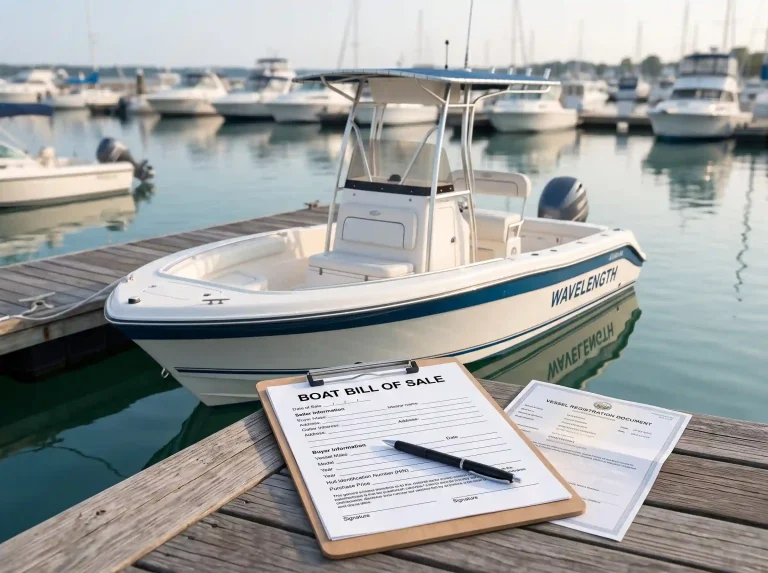

How to Write a Boat Bill of Sale: Complete Guide, Template
A boat bill of sale is a written record of a boat transaction between a buyer and seller. It identifies the vessel, states the purchase price and sale date, records the parties involved, and documents the transfer of ownership.
A boat bill of sale can support title transfer, registration, tax reporting, and proof of purchase. Requirements vary by state, so a generic Boat Bill template should be checked against the buyer’s state requirements before signing.
What Should a Boat Bill of Sale Include?
A complete boat bill of sale should identify the buyer, seller, vessel, transaction, and ownership terms. The exact requirements vary by state, but including complete information reduces problems during registration and title transfer.
Buyer and Seller Information
Include each party’s full legal name, address, and contact information. The names should match the identification and ownership documents used for the transaction.
Boat Information
Include the boat’s:
- Make
- Model
- Year
- Hull Identification Number (HIN)
- Vessel type
- Registration or title number, if applicable
The HIN is especially important because it uniquely identifies the vessel. Verify it against the boat and title before signing.
Sale and Payment Details
State the agreed purchase price, sale date, payment method, and any outstanding payment terms. If a deposit or installment arrangement exists, document it clearly.
Condition and Included Items
State whether the boat is sold as-is or with specific warranties. Identify equipment included in the sale, such as an outboard motor, trailer, electronics, or accessories.
Liens and Ownership
The seller should disclose known liens or encumbrances. A buyer should verify that the seller has the legal right to sell the boat before completing payment.
Key takeaway: A strong bill of sale connects the buyer and seller to a specific vessel, price, ownership condition, and transaction date.
How to Write a Boat Bill of Sale Step by Step
Writing a boat bill of sale is mainly a matter of recording the transaction accurately and completely.
Step 1: Identify the Parties
Write the full legal names and addresses of the buyer and seller. If a business owns or purchases the boat, use its legal business name.
Step 2: Describe the Boat
Record the boat’s make, model, year, HIN, and title or registration information. Confirm that these details match the existing ownership documents.
Step 3: State the Purchase Terms
Enter the agreed purchase price, sale date, payment method, deposit, and remaining balance if applicable.
Step 4: Describe the Condition
State whether the boat is sold as-is or subject to specific warranties. Avoid vague promises about the vessel’s condition.
Step 5: List Included Property
Identify whether the transaction includes a trailer, motor, safety equipment, electronics, or other accessories. Separate descriptions can prevent later disputes.
Step 6: Disclose Liens
State whether the boat has any known liens or encumbrances. If a lien exists, document how it will be satisfied before or during the transfer.
Step 7: Add Signatures
The buyer and seller should sign and date the document. Keep a completed copy for each party and provide additional copies when required for title or registration.
Example: If John sells a 2020 fishing boat to Maria for $28,000 with its trailer and outboard motor, the bill of sale should identify John and Maria, the boat’s HIN, the $28,000 price, the included equipment, the sale date, and both signatures.
Key takeaway: Write the bill of sale around five facts: who sold it, who bought it, what was sold, how much it cost, and when ownership changed.
Boat Bill of Sale Example and Template Fields
A practical Boat Bill of Sale Template can use the following structure:
| Section | Information to Include |
|---|---|
| Seller | Full legal name and address |
| Buyer | Full legal name and address |
| Vessel | Make, model, year, type, HIN |
| Title/Registration | Existing identification numbers |
| Purchase Price | Total agreed amount |
| Payment | Deposit, balance, payment method |
| Sale Date | Date of ownership transaction |
| Condition | As-is or stated warranties |
| Included Items | Trailer, motor, equipment |
| Liens | Existing or released liens |
| Signatures | Buyer and seller signatures |
| Notary | If required by applicable rules |
A template should function as a transaction record, not merely a receipt. The more accurately it connects the parties, vessel, payment, and ownership terms, the more useful it becomes for later documentation.If you want to prepare the document quickly, use our Boat Bill of Sale Template and fill in the required transaction details.
For a federally documented vessel, use the applicable U.S. Coast Guard National Vessel Documentation Center requirements rather than assuming a generic state form is sufficient.
Key takeaway: Use a structured template that captures every material transaction detail before the buyer and seller sign it.
What Should You Check Before Signing?
Before signing, compare the bill of sale against the boat, title, registration records, and agreed transaction terms.
Before-Signing Checklist
- Verify the seller’s legal name.
- Verify the buyer’s legal name.
- Match the HIN to the vessel.
- Check the title or ownership documentation.
- Confirm the purchase price.
- Confirm the sale date.
- Identify included equipment.
- Check for liens or encumbrances.
- Confirm the boat’s condition.
- Review payment terms.
- Confirm required signatures.
- Check state-specific requirements.
A buyer should not rely solely on the seller’s statement that the boat is free of liens. Ownership and lien information should be verified through the appropriate records when available.Before completing the purchase, make sure the boat fits your financing budget. Use our boat loan calculator to estimate monthly payments and understand the financing cost before signing the sale documents.
Key takeaway: The most important pre-signing check is consistency: the people, vessel identification, ownership documents, price, and transaction terms should all match.
Does a Boat Bill of Sale Need to Be Notarized?
Notarization depends on the applicable state requirements and the type of vessel transaction. Some jurisdictions may require notarization for particular title or registration transactions, while others may not.
Federally documented vessels require separate attention. The U.S. Coast Guard’s CG-1340 Bill of Sale includes an acknowledgment section for execution before a notary public or other authorized official.
Therefore, do not assume that a generic boat bill of sale has the same requirements as an official federal documentation form.
Key takeaway: Check the applicable state boating authority or federal documentation requirements before deciding whether notarization is necessary.
Boat Bill of Sale Requirements by State
Boat bill of sale requirements vary by state. Before signing, check the state DMV, Department of Natural Resources, Fish and Wildlife agency, or designated boating authority responsible for vessel registration and title transfers.
Verify these requirements:
- Whether an official bill-of-sale form is required
- Whether the bill of sale must be notarized
- Whether the HIN must appear on the document
- Whether the original title must accompany the bill of sale
- How sales tax is reported or collected
- Which documents are required for registration
- Whether buyer and seller signatures have specific requirements
Requirements vary by state. Verify current title, registration, tax, and notarization requirements with the authority responsible for vessel registration in your state.
State Requirement Decision Framework
If your state provides an official form: use that form when required.
If your state accepts a general bill of sale: use a detailed template containing the required buyer, seller, vessel, price, date, and signature information.
If the boat is federally documented: follow the U.S. Coast Guard documentation requirements separately.
If the purchase crosses state lines: verify the requirements of the state where the boat will be titled or registered.
Key takeaway: A generic boat bill of sale is a starting point; always verify the current requirements with the authority handling the vessel’s title or registration.
Special Boat Sale Situations
Some transactions require information beyond a standard boat sale.
Boat With Trailer or Motor
If the trailer or outboard motor is included, identify it separately when possible. Record identifying information such as a serial number, title number, or VIN when applicable.
Boat With an Existing Lien
A lien should not be ignored in the bill of sale. Document the outstanding lien and establish how it will be released before ownership is transferred.
Gift or Trade
A gift or trade may require different transaction and tax documentation than a standard cash sale. Do not describe a transaction as a conventional sale if no purchase price was actually paid.
Missing Title
A bill of sale does not automatically replace a missing title. The buyer should determine the applicable replacement-title and ownership-transfer process before completing the transaction.
Federally Documented Vessel
A federally documented vessel follows U.S. Coast Guard documentation procedures. The applicable federal form and supporting documents should be used instead of relying exclusively on a generic state template.
Key takeaway: Non-standard transactions should be documented according to their actual circumstances rather than forced into a basic boat-sale template.
Common Boat Bill of Sale Mistakes
| Mistake | Potential Problem | Better Approach |
|---|---|---|
| Incorrect HIN | Registration or ownership issues | Match the HIN to the vessel and documents |
| Name mismatch | Transfer delays | Use legal names consistently |
| Missing signatures | Weak transaction record | Sign and date all required sections |
| Unclear price | Payment or tax disputes | State the exact agreed amount |
| Undisclosed lien | Ownership complications | Verify and document lien status |
| Missing equipment details | Post-sale disputes | List included items |
| Ignoring state rules | Registration problems | Check current state requirements |
| Using the wrong federal form | Documentation problems | Follow USCG requirements for documented vessels |
A common mistake is treating the bill of sale as the entire ownership-transfer process. It is one part of the transaction record; title, registration, tax, and federal documentation requirements may involve additional documents.
Key takeaway: Most preventable problems come from inaccurate vessel information, incomplete transaction terms, missing signatures, or failure to verify applicable requirements.
Boat Bill of Sale Checklist
Before completing the sale, confirm:
Parties
- Buyer identified
- Seller identified
- Addresses recorded
Vessel
- Make verified
- Model verified
- Year verified
- HIN verified
- Title or registration checked
Transaction
- Purchase price recorded
- Sale date recorded
- Payment terms documented
- Condition stated
Ownership
- Liens checked
- Seller’s ownership verified
- Included trailer and motor identified
Completion
- Required signatures added
- Notarization checked
- Copies retained
- State registration requirements reviewed
This checklist helps ensure the bill of sale is complete before money and ownership change hands.
Key takeaway: Do not sign until the vessel identity, ownership status, payment terms, signatures, and applicable registration requirements have been verified.
Frequently Asked Questions
Is a boat bill of sale required?
Requirements vary by state and transaction type. Many boat transfers require proof of purchase for title or registration, while some jurisdictions prescribe a specific form or additional documentation.
Can I write my own boat bill of sale?
You can generally create a bill of sale containing the required transaction details, but state requirements may specify an official form or additional information. Verify the applicable rules before signing.
Can I use a generic boat bill of sale template?
A generic template can provide a useful structure, but it may not satisfy every state’s requirements. Check local title, registration, tax, and notarization rules before using it.
Does a boat bill of sale prove ownership?
A bill of sale documents the transaction and can support an ownership transfer, but it may not replace a title, registration, or federal documentation required by the applicable authority.
Does a boat bill of sale need to be notarized?
Not always. Notarization requirements depend on the jurisdiction and transaction. Federally documented vessels have specific U.S. Coast Guard documentation requirements.
Should the HIN be included?
Yes. Including the Hull Identification Number connects the transaction record to the specific vessel and helps prevent identification errors.
Should the trailer be listed?
If the trailer is part of the transaction, list it separately and include its applicable identifying information. Boat and trailer ownership documents may be handled separately.
What if the boat has no title?
Do not assume the bill of sale solves the problem. Check the applicable state’s replacement-title and ownership-transfer process before completing the purchase.
How long should I keep the bill of sale?
Keep the signed bill of sale with your boat ownership records for as long as needed to support ownership, registration, tax, warranty, insurance, or future-sale documentation.

Michael Carter is a financial research writer specializing in vehicle financing, loan calculations, interest rates, and consumer budgeting. He creates practical, easy-to-understand resources that help readers make more informed financing decisions.