Boat Bill of Sale Requirements by State: Notarization, Title & Trailer Rules
Boat bill of sale requirements by state are not the same document from one place to the next, and that catches most sellers off guard mid-sale. A form that works for a private-party sale in Texas can get rejected at a Kentucky county clerk’s office for missing a notary signature, or at a title office in Ohio for the same reason. The buyer and seller end up standing at the DMV, DNR, or marine board counter with a signed bill of sale that satisfies the wrong state’s rule, while the boat’s title, registration, and even the trailer’s paperwork sit unresolved.
This page checks that rule directly against each state’s own agency, not against another template site’s guess. The state-by-state breakdown below shows whether a plain signature is enough or a notary is required, whether a title or a bill of sale settles the transfer, how a boat trailer’s paperwork is handled separately from the boat’s hull identification number, and what a lender still asks for once the purchase is being financed rather than paid outright. Looking for one state only? Jump to the reference table.
Why Requirements Differ by State
No federal law sets bill of sale rules for boats. Each state’s motor vehicle department, wildlife agency, or marine board writes its own rule for boat sales. That is why one state accepts a plain signed bill of sale and another demands a notary.
Three things change from state to state: whether notarization is required, whether a title is mandatory or a bill of sale alone is enough, and how a boat trailer is documented separately from the boat itself. A bill of sale is one document inside the larger process of buying a boat privately, and the state’s rule for it applies regardless of how the purchase is paid for.
A common claim circulating online says only two states, Louisiana and West Virginia, require a notarized bill of sale. That claim does not hold up against each state’s own agency. Louisiana’s wildlife and fisheries department makes no mention of a notarization requirement on its official transfer pages. West Virginia’s rule only applies when the sale price is under 50% of the boat’s book value, not to every sale. The actual list of states with a real notarization requirement is different, and longer, than two.
Does Your State Require Notarization?
Trim the list to 2-3 illustrative examples (West Virginia, South Carolina, Delaware) and close with: “The other seven conditional states, with the full breakdown, are in the reference table below.” Let the table carry the complete list.
Ten more states require notarization only in specific situations, not on every sale:
- West Virginia — only when the sale price is under 50% of the boat’s book value
- South Carolina — only for boats purchased from an out-of-state dealer
- New Jersey — only when a non-titling state’s registration, not a title, is used as proof of ownership
- Maryland — only when the title assignment is missing the price or sale date, or when the boat comes from a state that does not title boats
- Delaware — required unless both buyer and seller appear in person with photo ID
- Massachusetts — only when the seller’s signature is on a Rhode Island-issued title
- Montana — only for a bonded or lost-title transfer
- Wyoming — only to cover 30 days of temporary operation, not permanent registration
- Puerto Rico — only when the seller cannot appear in person
- Oklahoma — the title itself needs notarizing if that path is used, and a separate notarized hull identification number statement is always required regardless of path
Twenty-eight states do not require notarization for a private-party boat sale at all. A signed bill of sale with the buyer’s name, seller’s name, hull identification number, sale price, and date is enough on its own.
Eight states could not be confirmed either way from official sources: Iowa, Louisiana, Maine, Nebraska, New Hampshire, Utah, Vermont, and Washington. Their agencies list a bill of sale as a required document but do not state whether it must be notarized.
The exact rule for a specific state, next to its title requirement, is in the reference table further down this page.
Do You Need a Title, or Is a Bill of Sale Enough?
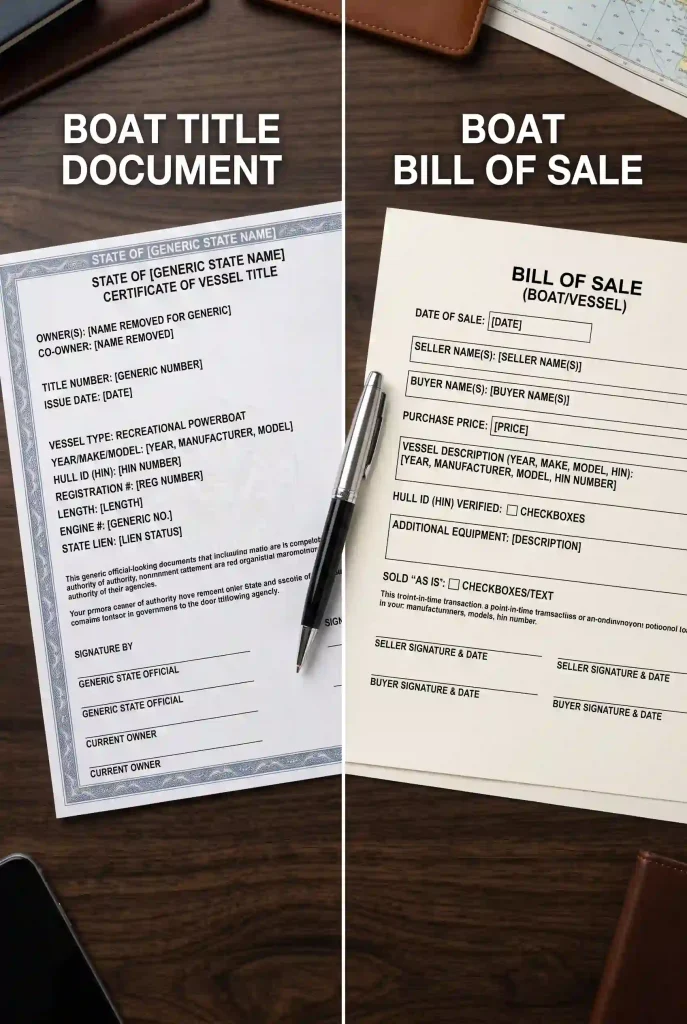
A bill of sale and a title do two different jobs. A bill of sale records the transaction: who sold the boat, to whom, for how much, and when. A title records legal ownership and is issued by the state.
Most states require a title for a boat above a minimum length, commonly 14 to 16 feet, and a bill of sale alone will not register a boat that size. Below that length, many states accept a bill of sale as the only ownership document.
Some states set a length threshold for when a title becomes mandatory North Carolina requires one at 14 feet and longer, and Wisconsin treats boats under 16 feet as non-titled. Below a state’s own threshold, a bill of sale alone is often enough; above it, a title is usually required. That cutoff is set individually by each state, so confirming it locally is worth doing before assuming a boat is title-exempt.
Where a title exists, the title’s own assignment section, not a separate bill of sale, is usually the document that legally transfers ownership. A bill of sale becomes the primary transfer document only when no title exists for that boat, or when the state specifically requires one alongside the title.
The full title transfer process, including what happens when a lien or a missing title complicates a sale, is covered in transferring a boat title.
Boat and Trailer: Does the Trailer Need Separate Paperwork?
A boat and its trailer are two separate pieces of property under most state law. That means one bill of sale covering both is not always enough to complete the transfer.
Texas is a documented example of this split. Texas Parks and Wildlife requires the trailer’s price to be listed separately from the boat and motor price on the paperwork, and the trailer itself is processed through the local county tax office, not the state boating agency. The boat and the trailer end up going through two different offices from the same private-party sale.
The general pattern that holds across most states:
- Trailers under the state’s own titling-weight threshold do not need their own title only registration, or nothing at all. That threshold is set individually by each state, not nationally, so confirming it with the state motor vehicle department before the sale is the reliable way to know it applies.
- Heavier trailers usually need a separate title, separate registration, and their own bill of sale listing the trailer’s VIN, not the boat’s hull identification number
- A single combined bill of sale listing both the boat and the trailer is accepted by many states for the sale itself, but it does not replace separate title or registration paperwork once the trailer crosses the state’s weight threshold
Confirming the trailer’s weight against the state motor vehicle department’s threshold before the sale avoids a registration that gets rejected after the fact.
State-by-State Quick Reference Table
| State | Notarization Required | Title Required |
|---|---|---|
| Alabama | No | Title, or bill of sale if untitled |
| Alaska | No | Title in most cases |
| Arizona | No | Bill of sale with signature and HIN |
| Arkansas | No | Change the Title Required cell to: “Bill of sale with HIN and county assessment proof” drop the titling-policy claim until it’s confirmed against Arkansas’s boat title statute directly. |
| California | No | Bill of sale accepted |
| Colorado | No | Bill of sale as proof of ownership |
| Connecticut | No | Bill of sale |
| Delaware | Conditional | Notarized bill of sale, unless both parties appear in person |
| Florida | No | Title |
| Georgia | No | Signed bill of sale |
| Hawaii | Yes | Add a “Source” column linking each state’s agency (e.g., Hawaii → HI DLNR, linked to dlnr.hawaii.gov/dobor/nr16-105b/) at minimum for the 6 required and 10 conditional rows, since those are the ones readers are most likely to double-check. |
| Idaho | No | Bill of sale |
| Illinois | No | Bill of sale, plus title if applicable |
| Indiana | No | Standard bill of sale |
| Iowa | Unclear | Bill of sale, title if applicable |
| Kansas | No | Bill of sale not mandatory |
| Kentucky | Yes | Notarized title transfer |
| Louisiana | Unclear | Bill of Sale of Boat/Motor form |
| Maine | Unclear | Sales tax proof for new registrations |
| Maryland | Conditional | Title, or notarized bill of sale for non-title-state boats |
| Massachusetts | Conditional | Bill of sale plus signed proof of ownership |
| Michigan | No | Bill of sale, prior registration, or title |
| Minnesota | No | Signed title, or bill of sale if non-titled |
| Mississippi | Yes | Title plus notarized or witnessed bill of sale |
| Missouri | No | MSO, title, or descriptive bill of sale |
| Montana | Conditional | Title required for motorboats and PWC |
| Nebraska | Unclear | Application for boat number and certificate |
| Nevada | No | Title or bill of sale |
| New Hampshire | Unclear | Registration through NH DMV |
| New Jersey | Conditional | Title normally; notarized bill of sale for non-titling-state sellers |
| New Mexico | No | Outstanding title is the primary document |
| New York | No | Bill of sale plus signed transfer section |
| North Carolina | Yes | Vessels 14ft and longer must be titled |
| North Dakota | No | Registration card or title |
| Ohio | Yes | Notarized title transfer required |
| Oklahoma | Conditional | Title, out-of-state title, or bill of sale for non-titling states |
| Oregon | No | Signed title release |
| Pennsylvania | No | Signed title, or bill of sale if never titled |
| Rhode Island | Yes | Notarized title transfer required |
| South Carolina | Conditional | Title and registration required |
| South Dakota | No | MSO, bill of sale, or dealer invoice |
| Tennessee | No | Registration only, no title system |
| Texas | No | Signed bill of sale or invoice |
| Utah | Unclear | Contact DMV for vessel-specific guidance |
| Vermont | Unclear | Title required |
| Virginia | No | Title if previously titled, bill of sale if not |
| Washington | Unclear | Vessel title application plus ownership documents |
| West Virginia | Conditional | Title required |
| Wisconsin | No | Certificate of title required |
| Wyoming | Conditional | County-issued title for permanent registration |
| District of Columbia | No | Bill of sale, or title/registration from seller |
| Puerto Rico | Conditional | In-person transfer before a Navigation Commissioner representative |
State requirements change. Confirming the current rule with the state agency before finalizing a sale is worth the extra step, especially in the ten conditional states listed above.
If You’re Financing the Purchase, What Your Lender Will Need
State law is not the only requirement placed on a bill of sale. A lender financing the purchase adds its own, on top of whatever boat financing option the buyer has already chosen.
For a private-party boat purchase, buying from an individual rather than a dealer, a signed bill of sale is usually the lender’s proof of the agreed purchase price. Underwriting uses that price, along with the boat’s specifications, to set the loan amount and confirm the down payment. the same numbers you can estimate your monthly payment with before the offer is finalized. Without it, a lender has no independent document confirming what the buyer actually agreed to pay.
Documents a lender typically asks for on a private-party boat loan, alongside the bill of sale:
- Proof of the boat’s value, through a survey or appraisal depending on loan amount and boat age
- The seller’s title, or proof the seller holds clear ownership
- The buyer’s income and credit documentation
A notarized bill of sale, in the states that require one, also satisfies most lenders’ documentation standard on its own. A lender does not usually ask for a separate notarization on top of what the state already requires.
Confirming boat loan requirements before finalizing a purchase agreement with a seller avoids a financing delay after the price is already locked in, and getting pre-approved for a boat loan beforehand sets the exact price range to negotiate within.
Frequently Asked Questions
Does a boat bill of sale need to be notarized?
It depends on the state. Six states require it in every case, about ten require it only in specific situations, and most states do not require it at all. The reference table above lists the exact rule by state.
Can you sell a boat without a title?
Only in states that do not title boats, such as Tennessee, or for boats under the state’s titling-length threshold. Where a title exists for the boat, it must be assigned to the new owner as part of the sale.
Do the boat and trailer need separate bills of sale?
Often, once the trailer crosses the state’s weight threshold for its own title. Below that threshold, one combined bill of sale is usually accepted for the sale itself.
Does a lender need a copy of the bill of sale for a financed boat purchase?
Yes, in almost all private-party financing cases. It is the lender’s proof of the agreed purchase price.
What happens if the hull identification number is missing or unreadable?
In several states, a missing or unreadable hull identification number triggers a physical inspection, a photo, or a pencil tracing before the agency will title or register the boat.
What should a boat bill of sale include besides the price?
The seller’s and buyer’s names, the boat’s hull identification number, make, model, year, sale date, and both signatures. The complete field-by-field format is covered in writing a boat bill of sale, and a ready-to-use template is available as a free boat bill of sale template.
Is anything else required after drafting a boat bill of sale?
Yes. The bill of sale supports the sale registering the boat, paying any state sales tax, and transferring or applying for a title where one is required still have to happen separately with the state agency.”

Michael Carter is a financial research writer specializing in vehicle financing, loan calculations, interest rates, and consumer budgeting. He creates practical, easy-to-understand resources that help readers make more informed financing decisions.