
Financing a Boat: Step-by-Step Guide 2026
Buying a boat can feel straightforward until you start comparing prices, down payments, interest rates, loan terms, and lender requirements. Financing a Boat becomes confusing when you do not know how much you can afford or which financing option fits your budget.
The solution is to approach financing step by step: set a realistic budget, check your credit, compare lenders, get preapproved, verify the boat, and review the full loan cost before signing. This process helps you avoid expensive financing mistakes and choose a boat loan that fits your long-term budget.
What Is Boat Financing?
Boat financing is the process of borrowing money to purchase a new or used boat and repaying the lender through scheduled payments. A boat loan may be secured by the vessel itself or offered as an unsecured personal loan. Your credit, income, down payment, loan amount, APR, and boat details can affect approval and cost.
Unlike ordinary consumer lending, marine financing can evaluate both you and the boat. The lender may consider the vessel’s value, age, condition, title, HIN, and intended use.
How Much Boat Can You Afford?
Your affordable boat price depends on more than the monthly loan payment. Include the down payment, APR, taxes, insurance, fuel, maintenance, storage, registration, and marina costs when setting your budget.
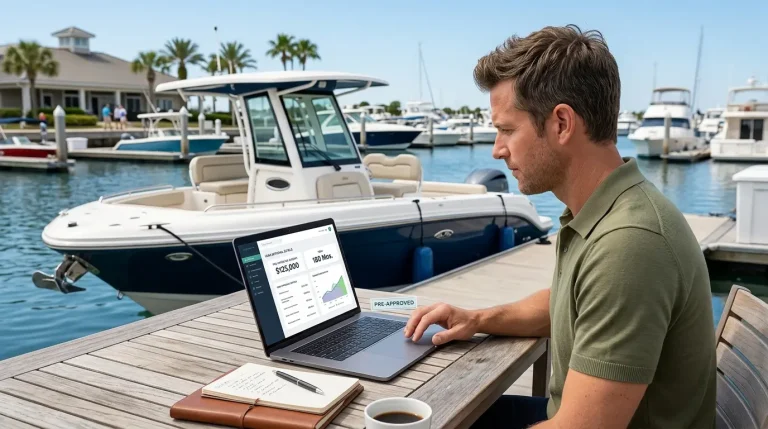
A practical starting point is to calculate the payment you can comfortably handle, then add recurring ownership expenses. A Boat Loan Calculator can estimate different loan amounts and terms before you contact lenders.
What Do Lenders Look for When Financing a Boat?
Lenders evaluate both the borrower and the boat. Borrower factors include credit score, income, debt-to-income ratio, credit history, down payment, and requested loan amount. Vessel factors can include age, value, condition, title, HIN, and intended use.
A strong financial profile does not guarantee approval if the boat fails the lender’s requirements. Likewise, a financeable vessel does not guarantee approval if the borrower’s income, credit, or debt profile does not meet underwriting standards.
Where Can You Finance a Boat?
You can finance a boat through a bank, credit union, marine lender, boat dealer, or other financing provider. The best option depends on your credit profile, purchase type, desired term, and total borrowing cost.
| Financing Source | Best For | Main Consideration |
|---|---|---|
| Marine lender | Boat-specific financing | Vessel requirements |
| Credit union | Competitive financing | Membership requirements |
| Bank | Existing banking customers | Qualification criteria |
| Dealer financing | Convenient purchases | Compare the final APR and fees |
| Personal loan | Simpler transactions | May have different rates and terms |
Compare more than the advertised monthly payment.

Secured Boat Loan vs Personal Loan: Which Is Better?
A secured boat loan uses the boat as collateral, while a personal loan may not require the vessel as collateral. Secured financing can offer terms designed specifically for boats, but the lender can have rights against the vessel if you default.
A personal loan may provide greater flexibility, especially for smaller purchases or private transactions. Compare APR, fees, term, collateral requirements, and total interest before choosing.
How to Finance a Boat Step by Step
- Set your total budget. Include the purchase and ownership costs.
- Check your credit. Review your credit profile before applying.
- Estimate payments. Test loan amounts, APRs, terms, and down payments.
- Compare lenders. Review financing options before choosing a provider.
- Get prequalified or preapproved. Understand your likely borrowing range.
- Choose the boat. Confirm that the vessel meets lender requirements.
- Submit documents. Provide borrower and boat information.
- Complete underwriting. The lender verifies your finances and vessel.
- Review the loan agreement. Check APR, fees, term, payment, and penalties.
- Close and fund. Complete required paperwork before the lender releases funds.
What Documents Do You Need for a Boat Loan?
Borrower documents may include identification, income records, tax documents, employment information, and financial statements. The lender may also request details about existing debts.
Boat documents can include the Hull Identification Number (HIN), title, bill of sale, registration, valuation, and lien information. A marine survey may be required for certain boats, especially older or higher-value vessels.
Does the Boat Itself Affect Financing?
Yes. The boat can affect financing because lenders may evaluate its age, value, condition, title, lien status, HIN, and intended use. Older boats or unusual vessels may have fewer financing options or shorter available terms.
For a private-party purchase, verify the title and lien status before closing. A lender may also require a marine survey or independent valuation.
How to Get Preapproved for a Boat Loan
Prequalification gives you an early indication of potential financing, often using limited information and, depending on the lender, a soft credit inquiry. Preapproval generally requires a deeper review of your finances and can provide a more realistic borrowing range. Neither guarantees final funding.
After you select a boat, the lender may still verify the vessel, purchase documents, insurance, title, and other conditions before issuing final approval and funding.
How to Compare Boat Loan Offers
Compare offers using APR, interest rate, loan term, monthly payment, total interest, fees, and prepayment terms. A lower monthly payment is not necessarily the cheaper loan if it results from a longer term.
| Compare | Why It Matters |
|---|---|
| APR | Measures borrowing cost |
| Loan term | Affects payment and total interest |
| Fees | Increase total financing cost |
| Monthly payment | Determines cash-flow impact |
| Total interest | Shows long-term borrowing cost |
| Prepayment terms | Affect early payoff flexibility |
What Happens After Your Boat Loan Is Approved?
Loan approval may be conditional. The lender can still verify the boat’s title, insurance, purchase agreement, valuation, and other closing requirements before funding.
The final sequence is usually approval → conditions satisfied → loan documents signed → lien/title processing → funding → purchase completion. Exact requirements and timing vary by lender.
How to Finance a Used Boat or Private-Party Sale
Financing a used or privately sold boat may require additional verification. Confirm the vessel’s HIN, title, lien status, value, condition, and bill of sale before completing the purchase.
A marine survey may help establish condition and value. Ask the lender about private-party requirements before committing to the transaction.
What Does Boat Financing Really Cost?
The real cost includes more than principal and interest. Budget for APR, financing fees, sales tax, registration, insurance, survey costs, and other purchase expenses.
Your ongoing ownership budget should separately account for fuel, maintenance, storage, and marina fees. This gives you a more realistic picture of affordability.
Common Boat Financing Mistakes to Avoid
Avoid choosing a boat based only on its purchase price or monthly payment. Other common mistakes include accepting the first loan offer, ignoring fees, choosing an unnecessarily long term, skipping vessel verification, and failing to check private-sale liens.
Compare total borrowing costs and confirm the boat qualifies before signing financing documents.
Boat Financing Checklist
Before financing, confirm:
- Total purchase and ownership budget
- Credit profile
- Down payment
- Loan amount
- APR and term
- Multiple lender offers
- Preapproval requirements
- Boat HIN and title
- Lien status
- Marine survey, if required
- Insurance requirements
- Final loan agreement
Frequently Asked Questions About Financing a Boat
Can I finance a used boat?
Yes. Lender requirements may depend on the boat’s age, value, condition, and documentation.
Can I finance a boat from a private seller?
Yes, but the lender may require additional title, lien, valuation, and purchase documentation.
What credit score do I need for a boat loan?
Requirements vary by lender. Credit score is one factor alongside income, DTI, credit history, down payment, and boat eligibility.
Should I get preapproved before buying a boat?
Yes. Preapproval can establish a realistic financing range before you commit to a purchase.
What is the biggest boat financing mistake?
Focusing only on the monthly payment can hide higher total interest and ownership costs. Compare the complete financing and ownership cost before choosing a loan.
Does a boat loan require a marine survey?
Not every loan requires a survey. A lender may request a marine survey or valuation depending on the boat’s age, value, condition, and financing requirements.

Michael Carter is a financial research writer specializing in vehicle financing, loan calculations, interest rates, and consumer budgeting. He creates practical, easy-to-understand resources that help readers make more informed financing decisions.