Can You Refinance a Boat Loan? When It Saves You Money (and When It Doesn’t)
Can You Refinance a Boat Loan? Here Is How It Works
Yes, you can refinance a boat loan. The process works much like refinancing a car loan or a mortgage: a new lender pays off your existing loan and issues a fresh one, ideally at a lower interest rate or with better terms. Most marine lenders and credit unions offer boat loan refinancing, as long as you and the vessel meet their underwriting standards. But refinancing is not automatically a smart move. It costs money, it takes time, and the savings are only real if the math works in your favor.
This guide explains when refinancing a boat loan saves you real money, what it costs, what lenders require, and how to run the break-even math before you apply.
When Refinancing a Boat Loan Actually Saves Money
Refinancing makes the most sense when your situation has changed since you took out the original loan. The three most common reasons people refinance are:
- Interest rates have dropped. If current rates are a point or two below what you locked in, a refinance can cut both your monthly payment and your total interest bill. If you want to understand what separates a great rate from an average one, read our guide on how to get the best boat loan rate first.
- Your credit score has improved. Boat loan rates vary widely by credit tier. Borrowers with scores in the 740-plus range often see rates roughly a full point lower than borrowers in the mid-600s, so a jump from fair to excellent credit since your original purchase can translate into real savings.
- You want out of a balloon structure. Some marine loans end with a large balloon payment. Refinancing into a fully amortizing loan before that balloon comes due can save you from a painful lump sum. We explain how these loans work in our article on boat loan balloon payments.
Before you gather any paperwork, run the break-even calculation. Add up every closing cost, then divide that total by your monthly payment reduction. If refinancing costs $1,200 and drops your payment by $80 a month, you break even in 15 months. Every month after that is genuine savings. If you plan to sell the boat before the break-even point, refinancing probably is not worth it.
What It Costs to Refinance a Boat Loan
Refinancing is not free, and the fees vary with loan size, vessel type, and whether the boat is USCG documented. Typical closing costs for a straightforward boat loan refinance land between $500 and $1,500. The most common charges include:
- Origination fees: Some lenders charge 0.5% to 2% of the loan amount. Others advertise no origination fee but build the cost into a slightly higher rate.
- Marine survey: If the lender requires a condition-and-value survey, expect roughly $15 to $32 per foot of boat length. On a 30-foot vessel, that is about $450 to $960.
- USCG documentation exchange: For federally documented vessels, exchanging the Certificate of Documentation to show the new lienholder costs $84, plus $24 if the previous mortgagee’s consent is needed.
- State title and lien recording fees: These vary by state, from nominal amounts to $50 or more, plus a modest title search fee.
One cost people forget: check your existing loan for a boat loan prepayment penalty before you commit. Many modern marine lenders have dropped these clauses, but they still appear in some contracts, and a penalty can eat into your savings or wipe them out entirely.

What Lenders Require for a Boat Loan Refinance
Marine lenders evaluate both you and the boat before approving a refinance, and the bar is slightly higher than for an auto refinance because boats depreciate less predictably and are harder to repossess.
Borrower requirements
Most lenders look for a credit score of at least 680 to 700 for competitive rates. A debt-to-income ratio below 40% is a standard threshold, meaning your total monthly debt payments, including the new boat payment, should not exceed 40% of your gross monthly income. Lenders also want to see steady employment, and self-employed borrowers typically need two years of tax returns or profit-and-loss statements.
Vessel requirements
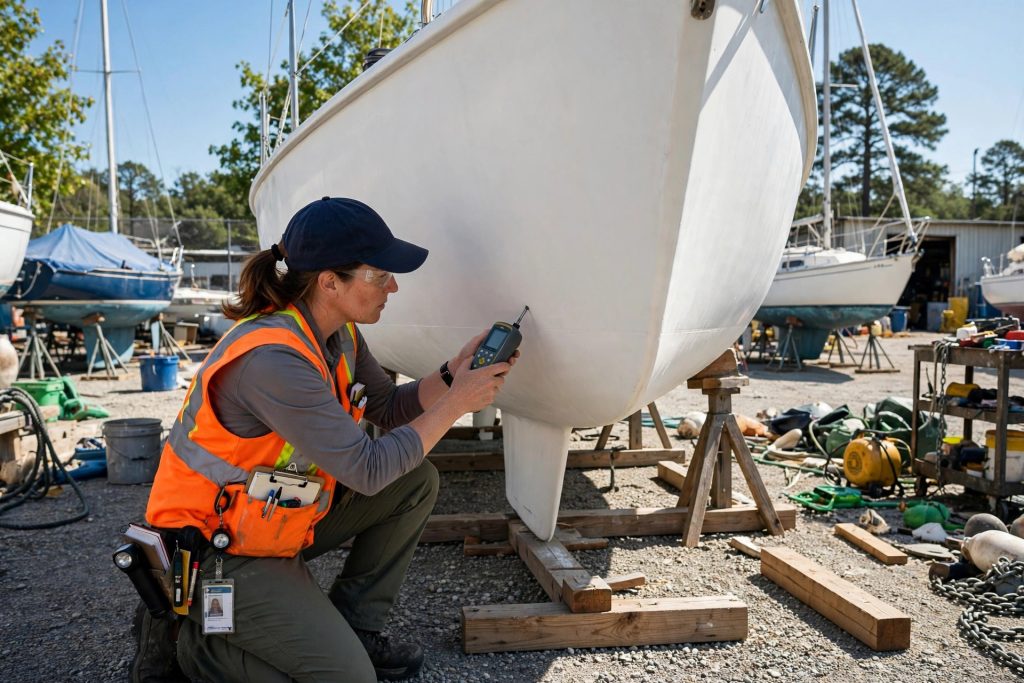
The boat itself has to qualify as acceptable collateral. Most lenders restrict refinancing to powerboats and multi-hull vessels under 15 to 20 years old. Wood-hulled, home-built, and personal watercraft or racing boats face tighter restrictions or exclusion. On the equity side, most marine lenders want the loan amount at or below 80% of the boat’s current market value. If you owe more than the boat is worth, you will need to bring cash to close the gap. Minimum loan amounts usually start between $10,000 and $25,000.
How the Refinance Process Works
There is no federal law setting a mandatory waiting period, but most borrowers can realistically refinance three to six months after the original closing. The real bottleneck is usually administrative: your state must finish processing the original title and lien paperwork before a new lender can record its own lien. That lag can take anywhere from a few weeks to a few months depending on the state. On top of that, many lenders want to see at least three months of on-time payments on the original loan before they approve a refinance.
Once you apply with a complete file, underwriting reviews your credit, income, debt ratios, and the vessel’s value and condition, including a title search to confirm there are no unexpected liens. Most applicants get a decision within a few business days. After approval, you sign a new promissory note and security agreement, and the new lender wires the payoff amount directly to your old lender.
Your first payment to the new lender is typically due 30 to 45 days after closing. Confirm the old lender shows a zero balance within 30 days, and if the old loan still appears open on your credit report after 60 days, contact the original lender to make sure the payoff was reported correctly.
When Refinancing Is a Bad Idea
Refinancing does not always save money. Watch out for these traps:
- Short remaining term. A rate drop of one to two points only produces real savings if you have more than five or six years left on the loan. On a $75,000 balance, cutting your rate by two points can save $10,000 or more in total interest. But if only a couple of years remain, there is not enough time to recoup closing costs.
- Extending the term. A lower monthly payment feels good, but if you stretch a 10-year loan into a new 20-year loan, you may pay far more in total interest. Compare the lifetime interest on both options with an amortization schedule before you sign.
- Resetting the clock. Refinancing a 10-year loan into a new 10-year loan after five years means 15 years of payments total. Choosing a shorter term on the new loan avoids this trap.
If your goal is simply to pay less interest overall and you have extra cash flow, making additional principal payments on your current loan is often the smarter move. Our guide on how to pay off a boat loan early walks through that strategy.
The Bottom Line
You can absolutely refinance a boat loan, and when rates have dropped or your credit has improved, it can save you thousands. The decision comes down to three questions: will the rate or terms be meaningfully better, do you have enough years left for the savings to beat the $500 to $1,500 in closing costs, and are you avoiding the term-extension trap? Answer those with real numbers, and you will know whether refinancing is right for you.

Michael Carter is a financial research writer specializing in vehicle financing, loan calculations, interest rates, and consumer budgeting. He creates practical, easy-to-understand resources that help readers make more informed financing decisions.