How to Finance a Pontoon Boat: Rates, Terms, and What Lenders Want
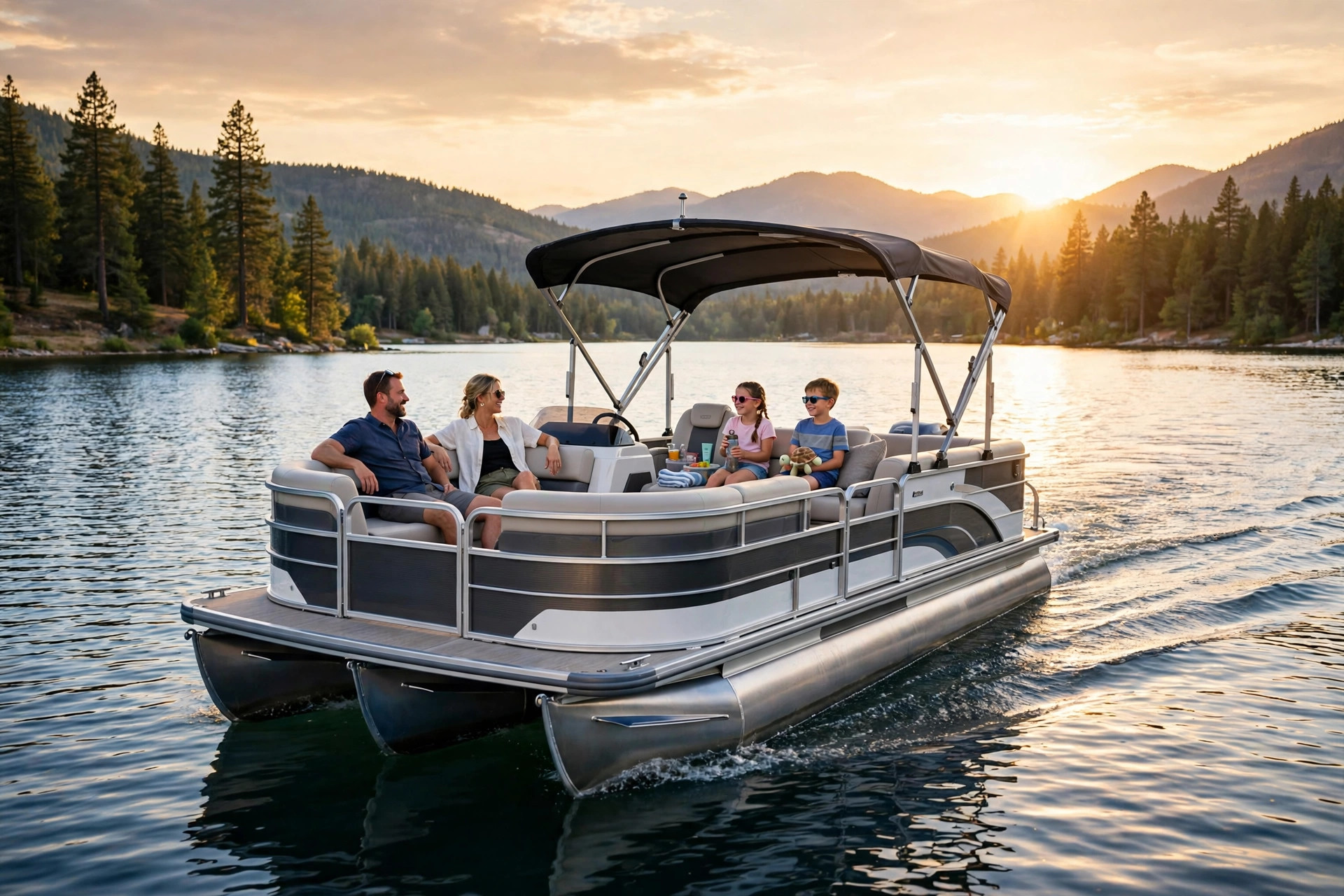
Learning how to finance a pontoon boat is the first real step toward owning one. A new pontoon usually costs between $20,000 and $100,000 or more, while a used one often sells for $10,000 to $50,000, so most buyers spread the cost over monthly payments instead of paying cash. Pontoon boats are one of the easiest types of boats to finance, because lenders know them well and many lenders compete for the business.
How to Finance a Pontoon Boat: The Main Loan Options
Most pontoon buyers use a secured marine loan. The boat itself serves as collateral, which keeps the interest rate lower than an unsecured loan. The lender checks the boat’s hull identification number, age, and value, then lends against it.
There are four common ways to borrow:
Marine lenders and banks. Specialist marine lenders and large banks offer secured boat loans with terms from 3 to 20 years. These are usually the best rates available, often in the range of 5% to 8% APR for strong borrowers.
Credit unions. Credit unions frequently offer the most competitive pontoon rates, sometimes with no down payment for qualified members.
Dealer financing. Many pontoon dealers arrange financing in-house through partner lenders. It is convenient, and dealers sometimes offer promotional rates on new models, but you should still compare the offer with a bank or credit union before signing.
Personal loans. An unsecured personal loan needs no collateral and works for cheaper used pontoons, but rates usually run from 7% to 15% and terms are shorter. Use this route only when the amount is small and the rate is fair. Before you commit, run the numbers on a pontoon boat loan calculator so you can see what each rate and term does to your monthly payment.
What a Pontoon Boat Loan Costs
Three numbers set your payment: the amount financed, the interest rate, and the loan term. The amount financed is the purchase price plus tax, title, registration, and any dealer fees, minus your down payment and any trade-in value.
Typical rates and terms
Rates on new pontoons can start around 6.95% APR for prime borrowers, while used pontoons usually start a little higher, around 7.45% APR for short terms, rising to about 9% to 9.90% APR on longer terms. Your exact rate depends on your credit score, the loan amount, the down payment, and the age of the boat. Terms commonly run from 36 to 240 months, with 60 months a frequent choice.
Down payment
Most lenders expect 10% to 20% down on a pontoon boat. Some lenders accept 10% to 15%, and a few consider zero-down financing for well-qualified buyers. A bigger down payment lowers your payment, cuts total interest, and improves your approval odds.
Costs beyond the loan payment
Budget for more than the monthly payment. Annual insurance typically runs $300 to $800. Storage and docking fees often run $1,000 to $5,000 a year, and routine maintenance usually costs $500 to $1,500 a year. Add fuel, registration, and winterizing on top. Buyers who budget only for the loan payment are the ones who feel squeezed by the second season, so work out the full yearly cost before you buy. A boat insurance guide can help you estimate coverage costs before you apply.

What Lenders Look For
Lenders judge a pontoon loan application on five things: your credit score, your provable income, your debt-to-income ratio, the boat’s age, and the loan amount.
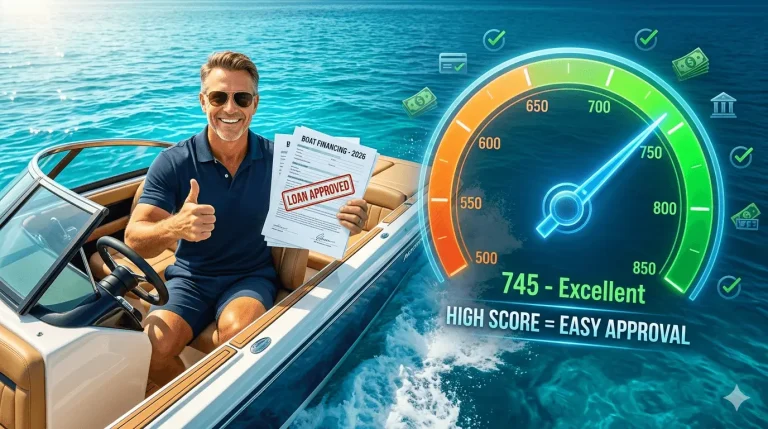
Credit score. Prime rates usually go to borrowers with scores of 700 or higher. Scores from 600 to 699 can still qualify but at higher rates. Some specialist marine lenders accept scores as low as 575 to 580, though they usually ask for more money down. If your score needs work, read our guide on how to get the best boat loan rate before you apply.
Income and debt-to-income ratio. Lenders want stable, documented income and a debt-to-income ratio under 40%, meaning your total monthly debt payments, including the new boat payment, should stay below 40% of gross monthly income.
Boat age and condition. Most marine lenders finance pontoons up to 20 years old, which covers most of the used market. Boats with salvage, rebuilt, or flood-damaged titles cannot be financed at any age. A marine survey is strongly recommended on any used pontoon before you buy, since it protects both you and the lender.
Documents. Have these ready: a government-issued ID, proof of income such as pay stubs or tax returns, and details of the boat including the hull identification number, year, make, and model.
New vs Used Pontoon Financing
New pontoons often qualify for longer terms and sometimes for manufacturer-subsidized promotional rates. Used pontoon financing usually carries a slightly higher rate and a shorter maximum term, because the collateral has less remaining life.
Neither is automatically the better buy. A three-year-old pontoon has already absorbed its steepest depreciation, so compare the total cost of each option, not just the monthly payment, and weigh warranty coverage and repair risk on the used side. Our comparison of new vs used boat financing covers the trade-offs in detail.
Step-by-Step: How to Get Approved
1. Check your credit and budget first. Pull your credit report, fix any errors, and work out the monthly payment you can carry comfortably, including insurance, storage, and fuel.
2. Get pre-approved before you shop. A pre-approved boat loan tells you exactly how much you can spend and lets you negotiate the boat price and the loan cost as two separate items. Approvals are usually good for 30 to 45 days, which is enough time to shop several dealers or a private seller. A decision typically comes back within one to two business days.
3. Compare at least two or three lenders. Do not accept the first offer. A small rate difference moves the payment noticeably, so comparing lenders is the easiest way to save money.
4. Pick the boat and confirm it qualifies. Check the boat’s age, title status, and value against the lender’s rules before you fall in love with it. If you buy from a dealer, the trailer and outboard motor can usually be bundled into the same loan when they appear on the same bill of sale.
5. Apply, sign, and close. Submit your documents and review the loan terms carefully before signing. From application to closing usually takes three to seven days, and funds are typically released one to three business days after signing. The lender usually pays the dealer or seller directly.
Common Mistakes to Avoid
Do not finance for the longest term just to get the lowest payment, because the extra interest adds up fast. Do not skip the survey on a used pontoon, and do not forget insurance and storage in your budget. Finally, do not let a dealer roll the boat price and the loan into one monthly payment figure. When price and financing blend together, you cannot tell which one moved, and that is how buyers overpay.
Financing a pontoon boat is straightforward once you know the numbers. Get pre-approved, compare lenders, keep the term as short as you can afford, and budget for the full cost of ownership.

Michael Carter is a financial research writer specializing in vehicle financing, loan calculations, interest rates, and consumer budgeting. He creates practical, easy-to-understand resources that help readers make more informed financing decisions.