
Boat Loan Credit Score: What Score Do You Need?
Worried your boat loan credit score is too low to qualify? There is no single credit score that every lender requires. Some lenders work with borrowers around 600, while others set higher thresholds. Your credit history, income, debt, down payment, loan amount, and the boat itself can also affect approval and financing terms.
A higher credit score can improve your chances of qualifying for competitive boat loan terms, but lenders usually review your complete financial profile rather than relying on your score alone. Comparing your credit, expected loan amount, down payment, and monthly budget before applying can help you choose a financing option that fits your situation.
What Credit Score Do You Need for a Boat Loan?
There is no universal minimum credit score for a boat loan. Lenders set their own requirements, and the same credit score can produce different results with different lenders.
As a general reference, a score around 680 or higher can put a borrower in a stronger position with many marine lenders. Some financing programs accept scores around 600, while other lenders may require 700 or more.
| Credit Score Range | General Position | What It May Mean |
|---|---|---|
| 700+ | Strong | More financing options may be available |
| 680–699 | Good | May qualify for competitive financing |
| 650–679 | Moderate | Approval and pricing depend more heavily on other factors |
| 600–649 | Lower | Some lenders may still consider the application |
| Below 600 | Challenging | Fewer financing options may be available |
These ranges are not universal approval standards. Lenders can use different underwriting models, loan limits, and boat-eligibility rules.
The important point is that your credit score is one part of the financing decision, not an automatic approval or rejection number.
How Does Your Credit Score Affect Boat Loan Approval and APR?
Your credit score can influence both whether you qualify and the financing terms you receive. A stronger credit profile generally gives lenders more confidence in your repayment history and may help you access more competitive interest rates.
For the current rate ranges lenders quote at each score level, see boat loan interest rates by credit score.
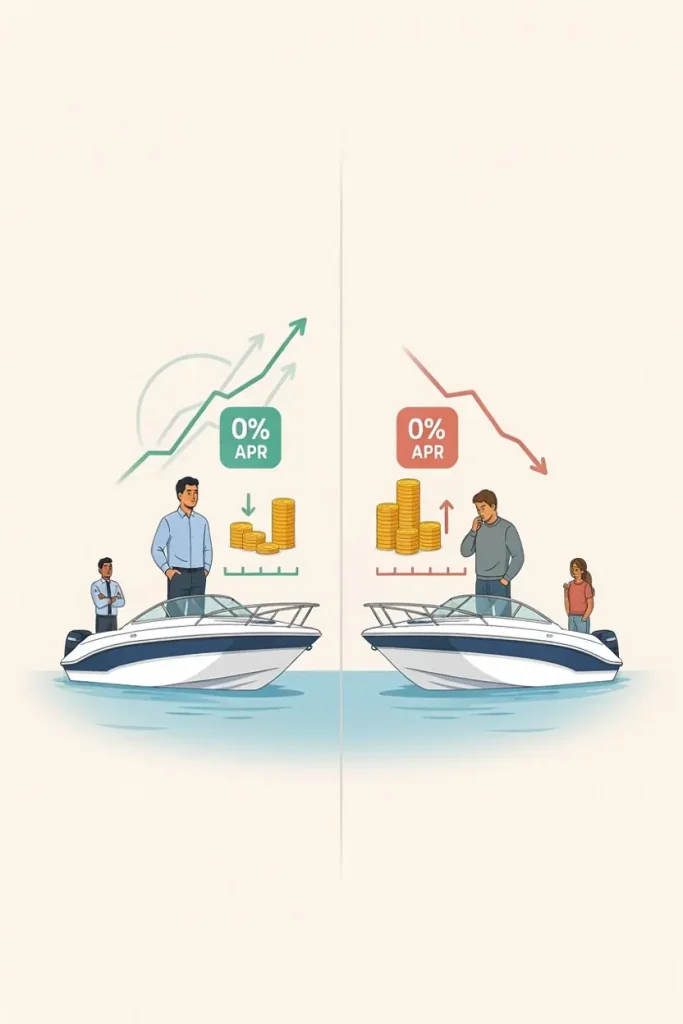
Approval and pricing are not the same thing. You could qualify for a boat loan with a lower credit score but receive a higher APR than a borrower with stronger credit.
For example, two borrowers could finance the same $50,000 boat but receive different rates because their credit profiles differ. The borrower with the stronger profile may pay less interest over the same repayment period.
Your credit score can therefore affect:
- Approval eligibility
- APR or interest rate
- Available loan terms
- Monthly payment
- Total interest cost
- Down payment requirements in some lending situations
Use the Boat Loan APR Calculator to compare how different interest rates could affect your borrowing costs.
What Else Do Lenders Consider Besides Credit Score?
A credit score does not tell the lender everything about your ability to repay a boat loan. Lenders can also review your income, existing debt, down payment, loan amount, and the boat being financed.
Income and employment: Lenders may verify income and employment to assess repayment capacity.
Debt-to-income ratio: Your DTI compares existing monthly debt obligations with income. A high DTI can make qualification more difficult even with a strong credit score.
Down payment: A larger down payment reduces the amount financed and can lower the loan-to-value ratio.
Loan-to-value ratio: LTV compares the loan amount with the eligible value of the boat. Lower LTV can reduce the lender’s exposure.
Boat characteristics: Boat age, condition, type, value, and resale potential can affect financing eligibility.
Assets and reserves: Some lenders may consider available assets or cash reserves when evaluating an application.
Because these factors work together, two borrowers with identical credit scores can receive different financing decisions. Check the boat loan eligibility requirements before applying.
Can You Get a Boat Loan With a Low Credit Score?
Yes, a lower credit score does not automatically prevent you from getting a boat loan. However, your lender options and available terms may become more limited.
A borrower with lower credit may strengthen an application through factors such as:
- A larger down payment
- Lower existing debt
- Stable and verifiable income
- A qualified co-borrower or co-signer where permitted
- Strong cash reserves
- A reasonably priced boat with acceptable collateral value
Lower credit can also result in a higher APR or stricter loan conditions. The key question is not only whether you can qualify, but whether the resulting loan is affordable.
A lender-specific minimum should therefore be treated as a starting point rather than a guarantee of approval.
Can a Larger Down Payment Help With a Lower Credit Score?
A larger down payment may strengthen a financing application, but it does not replace good credit.
Suppose you purchase a $60,000 boat. A 10% down payment means financing $54,000, while a 20% down payment means financing $48,000. The second scenario gives the lender less exposure and gives you more initial equity.
A larger down payment can:
- Reduce the loan balance.
- Lower the LTV ratio.
- Reduce monthly payments.
- Reduce total interest when other loan terms remain unchanged.
- Increase your initial equity in the boat.
However, using all your available savings for the down payment can create another problem. You may still need money for insurance, maintenance, registration, equipment, storage, fuel, and unexpected repairs.
Learn more about how the boat loan down payment can affect the amount you finance.
What Credit Score Is Considered Good for a Boat Loan?
A 700+ credit score is generally a strong credit position, but lenders use different credit tiers and underwriting criteria, so it does not guarantee approval or a specific APR.
A borrower with a 680 score and strong income, manageable debt, a reasonable loan amount, and a substantial down payment may have a stronger application than someone with a higher score but significant existing debt.
Think about credit in two stages:
Good enough to qualify: Your score and overall profile meet a lender’s underwriting requirements.
Strong enough for competitive terms: Your complete profile may qualify you for better pricing or more flexible financing.
There is no guaranteed score that produces a particular APR. Lenders evaluate the complete application.
Should You Improve Your Credit Before Applying for a Boat Loan?
If your credit is weak and you are not in a hurry to purchase, improving your profile before applying may be worthwhile. If your score is already strong and your income, debt, and down payment are suitable, delaying the application may provide less benefit.
Consider applying now if:
- Your credit history is stable.
- Your existing debt is manageable.
- You have reliable income.
- You have enough money for the required down payment.
- The expected monthly payment fits your budget.
Consider improving your profile first if:
- Your credit report contains errors.
- Your revolving credit utilization is high.
- You have recent missed payments.
- Your existing debt is already difficult to manage.
- You could qualify for materially better terms after improving your profile.
Before submitting applications, review your credit reports and compare lenders carefully. Where available, prequalification can help you understand potential options without immediately proceeding to a full credit application.
Boat Loan Credit Score FAQs
Can I get a boat loan with a 600 credit score?
Possibly. Some lenders accept borrowers around this level, but approval, loan amount, APR, and terms depend on the complete application.
Is a 700 credit score good enough for a boat loan?
A 700 score is generally a strong credit position, but it does not guarantee approval or a particular interest rate.
Does a co-signer help with a boat loan?
A qualified co-signer or co-borrower may strengthen an application with some lenders, but availability and requirements vary.
Does checking my credit score hurt my credit?
Checking your own credit score typically does not hurt your credit score. A lender’s full credit application may involve a hard inquiry, depending on the lender and application process.
Does credit score affect the required down payment?
It can. Lenders may consider credit alongside LTV, income, debt, loan amount, and boat characteristics when determining financing terms.
What credit score gets the best boat loan rates?
Higher credit scores generally improve the likelihood of competitive rates, but the best available APR depends on the lender and your complete financial profile.
Does a high credit score guarantee boat loan approval?
No. Lenders may also consider income, debt-to-income ratio, down payment, loan-to-value ratio, the loan amount, and the boat’s age and value.

Michael Carter is a financial research writer specializing in vehicle financing, loan calculations, interest rates, and consumer budgeting. He creates practical, easy-to-understand resources that help readers make more informed financing decisions.