
Boat Loan Down Payment Guide: How Much Do You Need?
A boat loan down payment is the amount you pay upfront toward the purchase price of a boat. The right amount depends on the lender, your credit profile, the boat’s value, and how much you can comfortably afford to pay without draining your savings.
Many buyers focus only on the monthly payment. However, your down payment can also affect your loan amount, interest costs, loan-to-value ratio, and the financing options available to you.
How Much Down Payment Do You Need for a Boat Loan?
A typical boat loan down payment may fall around 10% to 20% of the boat’s purchase price, although the actual requirement varies by lender and borrower.
For example:
| Boat Price | 10% Down | 15% Down | 20% Down |
|---|---|---|---|
| $30,000 | $3,000 | $4,500 | $6,000 |
| $50,000 | $5,000 | $7,500 | $10,000 |
| $100,000 | $10,000 | $15,000 | $20,000 |
The same principle applies when financing a boat in the UK, although the currency and lender criteria will differ.
A larger deposit reduces the amount you need to borrow. A smaller deposit preserves more cash but can increase your monthly payment and total borrowing costs.
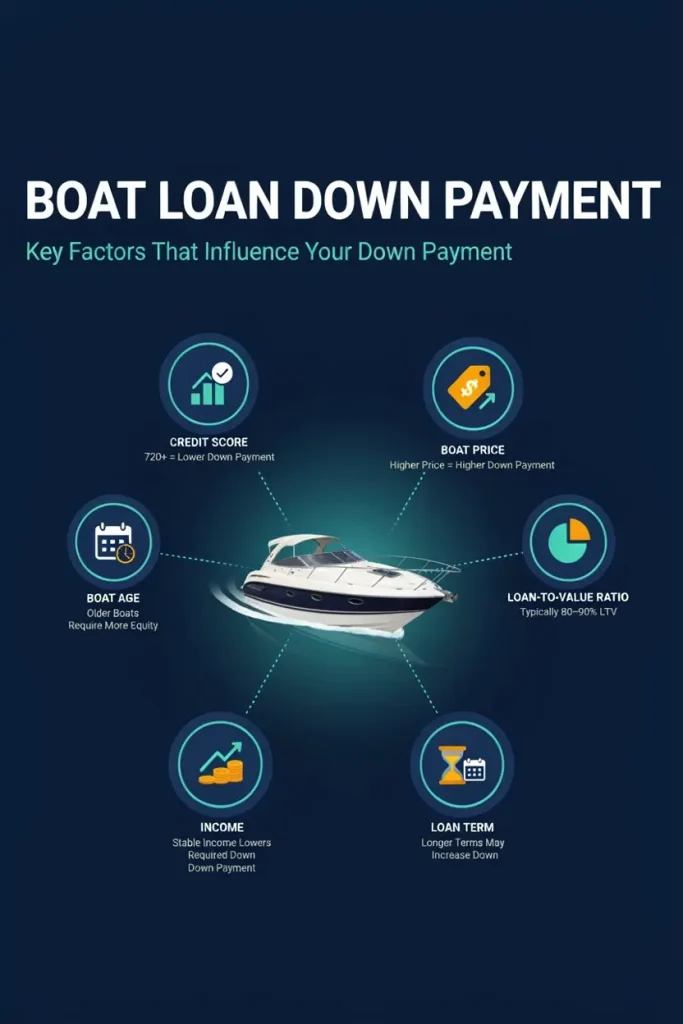
The exact amount you need is not determined by the boat price alone. Your financial profile and the boat itself can also influence the lender’s decision.
Your down payment is not always your total cash required at closing. Depending on the transaction and lender, you may also need to budget separately for costs such as insurance, registration, taxes, surveys, or other closing-related expenses.
What Determines Your Boat Loan Down Payment?
Lenders assess several factors when deciding how much money you need to put down.
Your Credit Profile
A stronger credit history may give you access to more flexible financing terms. A weaker credit profile may result in a higher required down payment or fewer available loan options.
The Boat’s Age and Condition
Newer boats can sometimes be easier to finance because their value is easier for lenders to assess. Used or older boats may carry more restrictions, particularly if the vessel has a lower resale value or requires significant repairs.
Loan-to-Value Ratio
The loan-to-value ratio, or LTV, compares the amount you borrow with the boat’s value.
For example, if a boat is worth $50,000 and you borrow $40,000, the loan represents 80% of the boat’s value.
A larger down payment lowers the LTV. This can reduce the lender’s risk because you have more equity in the boat from the beginning.
Loan Amount and Repayment Term
Larger loans may have different down payment requirements than smaller loans. The repayment term can also affect affordability because a longer term may lower the monthly payment while increasing the total interest paid.
Before choosing a deposit amount, it helps to see how different borrowing amounts change your estimated monthly payment. The boat loan calculator can help compare multiple down payment scenarios.Your credit profile, income, existing debt, loan amount, and the type and age of the boat may also affect approval. Check the full boat loan requirements and eligibility factors before applying for financing.
Can You Get a Boat Loan With 0% Down?
Yes, 0% down boat financing may be available in some situations, but it is not automatically available to every buyer or every boat.
A zero-down loan means you finance the full eligible purchase amount. This reduces your upfront cost, but you begin the loan with no equity contribution from your own funds.
A 0% down option may be more suitable when:
- You have a strong credit profile.
- You want to keep cash available for emergencies.
- The lender accepts full financing for the boat.
- The monthly payment fits comfortably within your budget.
However, borrowing more usually means paying more interest over the life of the loan.
A zero-down loan can be useful when preserving cash is important, but it should be compared against the long-term cost of borrowing the additional amount.
How a Larger Down Payment Changes Your Boat Loan
A larger down payment creates an immediate difference in three areas: the amount borrowed, the monthly payment, and the total interest cost.
Consider a $60,000 boat.
- With 10% down, you borrow $54,000 before any applicable fees.
- With 20% down, you borrow $48,000 before any applicable fees.
The second option reduces the principal balance by $6,000 from the start.
This usually means:
- Lower monthly repayments.
- Less interest paid over the loan term.
- A lower loan-to-value ratio.
- More equity in the boat from day one.
However, putting down the maximum amount is not always the best financial decision.
A buyer who uses all available savings for a down payment may have little money left for insurance, registration, maintenance, marina fees, equipment, or unexpected repairs.
The better decision is usually the amount that reduces borrowing costs without leaving you financially stretched.
You can compare how different interest rates affect your borrowing cost with the Boat Loan APR Calculator.A larger down payment reduces the amount you need to borrow, which can lower both your monthly payment and the total interest paid over the loan term. You can compare different down payment amounts with this boat loan payment calculator before deciding how much cash to put down.
New vs Used Boat Down Payment Requirements
The down payment requirement can differ between a new and used boat because lenders may evaluate the asset differently.
| Factor | New Boat | Used Boat |
|---|---|---|
| Value assessment | Usually more straightforward | May depend on age and condition |
| Financing availability | Often broader | May have lender restrictions |
| Depreciation concerns | Can be higher in early years | Depends on existing market value |
| Inspection needs | May be limited | Survey or inspection may be important |
| Down payment | Depends on lender and borrower | May vary based on vessel eligibility |
An older boat may require additional checks before financing. The lender may consider its age, condition, market value, and whether it meets the lender’s eligibility requirements.
This means a buyer should not assume that the same down payment percentage will apply to every boat.
Before applying, check the Boat Loan Requirements to understand how factors such as credit, income, boat eligibility, and documentation can affect approval.
How Much Should You Put Down on a Boat?
There is no single percentage that works for every buyer. A practical decision should balance your borrowing costs with your available cash.
Use this framework:
Choose a Lower Down Payment When
A lower down payment may make sense if you have limited available cash but can comfortably manage the higher monthly payment and total borrowing cost.
Consider 10% to 20% When
This range can provide a balance between reducing the loan amount and keeping funds available for other boat ownership expenses.
Consider a Larger Down Payment When
A larger deposit may make sense if you have sufficient savings, want to reduce interest costs, or want to borrow less relative to the boat’s value.
Before deciding, compare at least three scenarios. For example, calculate the estimated cost with 10%, 15%, and 20% down.
The best boat loan down payment is not necessarily the largest amount you can pay. It is the amount that keeps the loan affordable while leaving enough financial flexibility for the real cost of owning the boat.
Boat Loan Down Payment FAQs
What is the minimum down payment for a boat loan?
The minimum depends on the lender, your financial profile, and the boat being financed. Some loans may require a deposit, while certain borrowers may qualify for low-down-payment or zero-down financing.
Is 20% down required for a boat loan?
No. A 20% down payment is not a universal requirement. Some lenders may accept a smaller down payment depending on the borrower and the vessel.
Does a larger down payment lower the monthly payment?
Yes. A larger down payment reduces the amount borrowed, which generally lowers the monthly loan payment when other terms remain the same.
Can I use a trade-in as a boat loan down payment?
In some cases, the value of an eligible trade-in may contribute toward the purchase transaction. The lender or dealer will determine how the trade-in value is handled.
Should I put all my savings down on a boat?
Usually, no. A down payment should be balanced against other financial needs, including emergency savings and ongoing boat ownership costs.
The right boat loan down payment depends on your finances, the boat you want to buy, and the loan terms available to you. Compare several deposit amounts before applying so you can see how each option affects your monthly payment and total cost.

Michael Carter is a financial research writer specializing in vehicle financing, loan calculations, interest rates, and consumer budgeting. He creates practical, easy-to-understand resources that help readers make more informed financing decisions.