How Much Income Do You Need to Finance a Boat?
How much income do you need to finance a boat? The short answer is that lenders do not set a minimum salary for boat loans. What they actually look at is your debt-to-income ratio: how much of your gross monthly income already goes toward debt, and whether adding a boat payment keeps you inside their comfort zone. Once you understand the two key ratios, you can work out exactly which boat fits your income.
How Much Income Do You Need to Finance a Boat? The Honest Answer
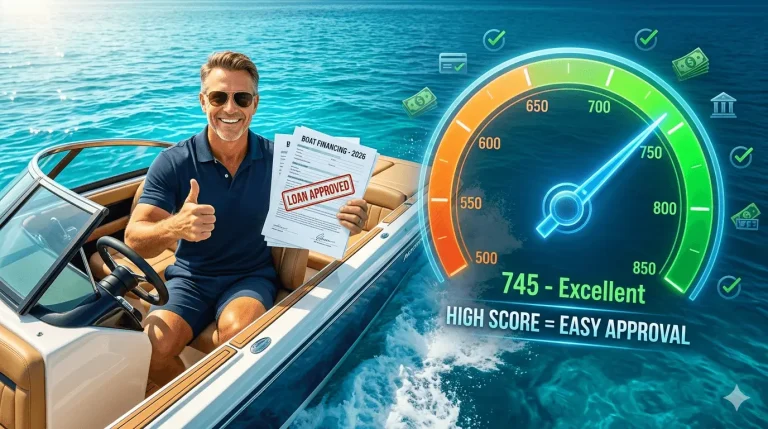
There is no fixed income number because two buyers with the same salary can get very different answers. A person earning $60,000 a year with no other debt can qualify for a boat loan that a person earning $120,000 a year with heavy debt cannot. Lenders care about the ratio between your income and your obligations, not the income figure alone. That said, most boat lenders draw the line when your total monthly debt payments, including the new boat payment, climb above roughly 36 percent of your gross monthly income. Some lenient lenders stretch this to 40 or 45 percent. Alongside that, they check your credit score, usually at least 680 for approval and 700 or higher for the best rates, and expect a down payment of 10 to 20 percent of the boat price. If you want the full picture of what lenders review, see the boat loan requirements guide.

Rule 1: Keep Your Boat Payment at 8 to 12 Percent of Gross Income
The first rule is a simple sanity check you can run before you ever talk to a lender. Divide your gross monthly income, that is your pay before taxes, into the monthly boat payment. If the payment sits under 8 percent of your income, the boat is comfortably affordable. Between 8 and 12 percent is the typical range where most financed boat purchases land. Over 12 percent and your budget starts getting stretched, because a boat payment never travels alone: insurance, storage, fuel, and maintenance all ride along with it. For example, on $8,333 of gross monthly income, the comfortable zone tops out around $1,000 per month. Run your own numbers with the boat affordability calculator before you shop.
Rule 2: Keep Total Debt Under 36 Percent of Income
The second rule is the one lenders actually use to approve or decline you. Add up every monthly debt payment you already have: mortgage or rent is not counted, but car payments, student loans, personal loans, and minimum credit card payments are. Then add the projected boat payment. Divide that total by your gross monthly income. That percentage is your debt-to-income ratio, and most boat lenders want it at 36 percent or less. Suppose you earn $5,000 a month, pay $900 toward existing debts, and are eyeing a boat with a $268 monthly payment. Your ratio is $1,168 divided by $5,000, or about 23 percent. That is well inside the comfort zone, which is why a modest income with low debt often beats a high income with high debt. If your ratio lands above 36 percent, you still have options, which we will cover below.
Real Examples: Three Incomes, Three Boats
Rules are easier to trust when you see real math. The payments below use the standard loan payment formula with fixed rates and the stated terms.
$60,000 income, $35,000 used boat. With a 20 percent down payment of $7,000, you finance $28,000 over 15 years at 8 percent. The payment comes to about $268 per month, which is 5.4 percent of the $5,000 gross monthly income. With $900 in existing monthly debt, the total debt-to-income ratio is 23.4 percent. Verdict: comfortably affordable.
$100,000 income, $65,000 boat. With a 15 percent down payment of $9,750, you finance $55,250 over 15 years at 7.5 percent. The payment is about $512 per month, or 6.1 percent of the $8,333 gross monthly income. With $2,400 in existing monthly debt, the ratio lands at 34.9 percent. Verdict: passes the 36 percent test with room to spare.
$150,000 income, $120,000 boat. With a 10 percent down payment of $12,000, you finance $108,000 over 20 years at 8 percent. The payment is about $903 per month, or 7.2 percent of the $12,500 gross monthly income. With $3,800 in existing monthly debt, the ratio reaches 37.6 percent. Verdict: just over the strict 36 percent line. This buyer likely gets approved only by putting more money down or paying off some debt first. Notice how the payment-to-income ratio looked fine at 7.2 percent, but the total-debt test caught the problem. That is exactly why lenders use both.
The Hidden Cost Most Buyers Forget: Ownership
Here is the trap that sinks many first-time buyers. A common planning rule says the full monthly cost of owning a boat runs roughly 1.5 to 2 times the loan payment. Insurance on a financed boat is usually required, plus storage or slip fees, fuel, registration, and repairs. Another way to see it: plan on 10 to 20 percent of the boat’s value per year in ownership costs on top of the loan. That $268 monthly payment from the first example really needs a budget closer to $400 to $500 a month once everything is included. When you test affordability, always size the whole cost, not just the payment. That discipline is what keeps a financed boat fun instead of stressful.
What Lenders Check Besides Your Income
Income is only one piece of the application. Your credit score sets your rate and sometimes your approval: most lenders want at least 680, while scores of 700 and above unlock the best terms. If yours needs work, read the boat loan credit score guide. Lenders also look at job stability and steady employment history, since a reliable paycheck is their real security. They weigh your down payment, typically 10 to 20 percent, because more of your own money in the boat lowers their risk. And the boat itself matters: most lenders will not finance vessels older than 10 to 15 years, and used boats often need a professional marine survey to confirm value and condition.
How to Lower the Income You Need
If the math says the boat you want is slightly out of reach, you have more levers than just earning more money. A larger down payment shrinks the loan amount and the payment, and it can also move your debt-to-income ratio into passing territory. Choosing a less expensive or slightly older boat often changes the picture dramatically, since both the payment and the insurance bill drop. Paying down an existing car loan or credit card before you apply is one of the fastest ways to fix a borderline ratio. A longer loan term lowers the payment too, but you will pay much more interest over time, so use it carefully. And if you are close but not quite there, a cosigner with strong credit can help you qualify. Finally, get pre-approved for a boat loan before you shop: it turns the vague question of how much income you need into a concrete number the lender has already signed off on.
The Bottom Line
So, how much income do you need to finance a boat? Enough that the payment stays at or under 8 to 12 percent of your gross monthly income, your total debts including the boat stay at or under 36 percent, and the full ownership cost still leaves your budget breathing room. Run both ratios honestly, size the whole cost, and you will know before you apply whether that vessel is a smart buy or a stretch you will regret.

Michael Carter is a financial research writer specializing in vehicle financing, loan calculations, interest rates, and consumer budgeting. He creates practical, easy-to-understand resources that help readers make more informed financing decisions.