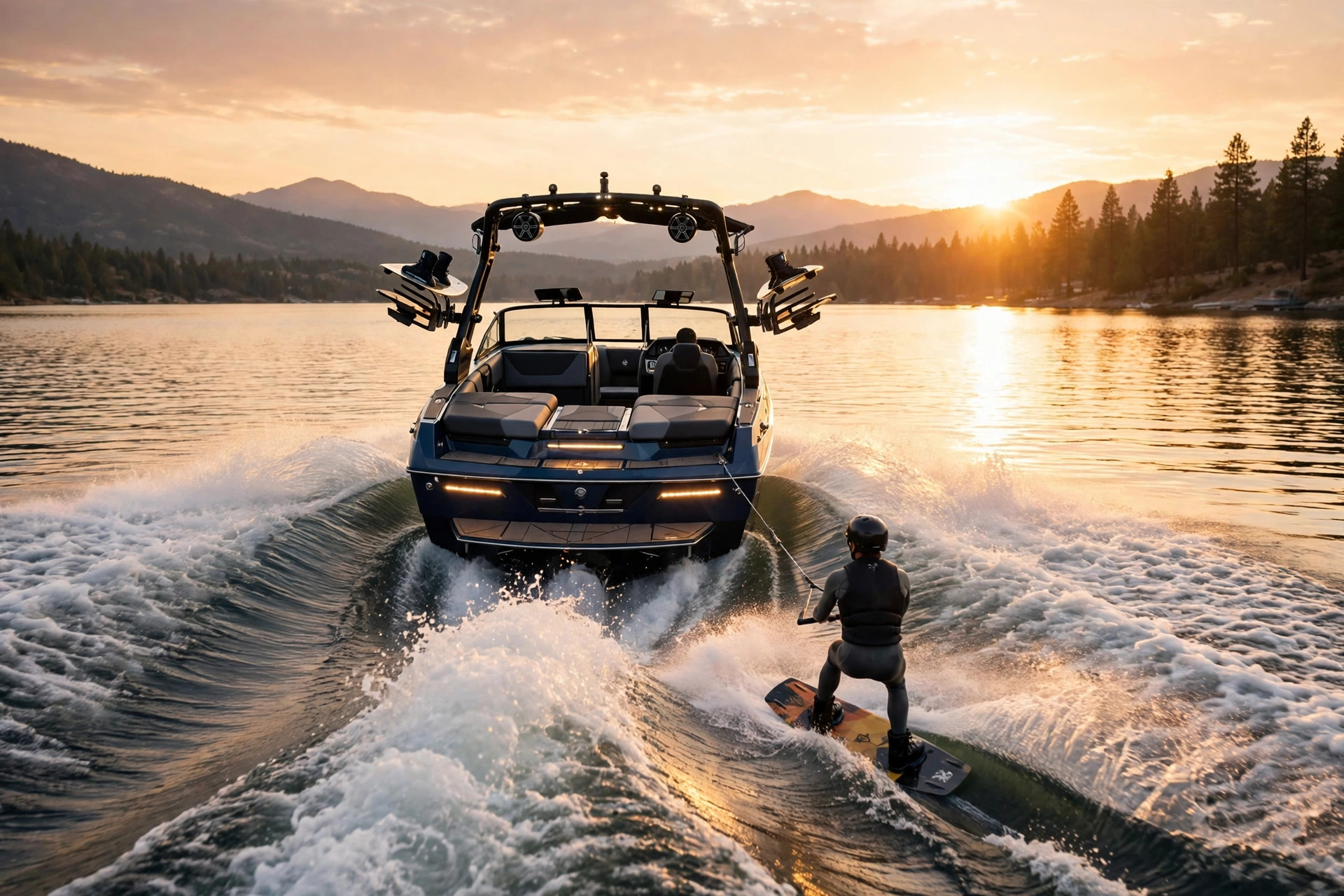
How to Finance a Wakeboard Boat: Loans, Rates and Costs
Learning how to finance a wakeboard boat is the first real step toward owning one. Wake boats are some of the most expensive boats on the water, so almost every buyer spreads the cost over monthly payments. The good news is that lenders know these boats well, and a strong brand name holds its value better than most boats, which works in your favor at application time.
What Does a Wakeboard Boat Cost in 2026?
Wake boats are priced in clear tiers. Entry level models such as the Axis A20 and Heyday WT-1 start around $75,000 to $110,000. Mid tier boats such as the MasterCraft NXT and Malibu 23 LSV usually run $110,000 to $175,000. Premium boats such as the MasterCraft XT series and Nautique G23 run $175,000 to $275,000, and ultra premium flagships such as the Nautique Paragon and Malibu M242 start above $275,000. Malibu lists its flagship M242 from $280,747.
Used wake boats hold value well: a five year old MasterCraft or Nautique typically keeps 65 to 75 percent of its original value, so a used boat in good shape is often the smartest buy, and that strong resale value also helps your loan. New boats often qualify for longer terms and sometimes for promotional rates, while used boats usually carry a slightly higher rate and a shorter maximum term. Our comparison of new vs used boat financing covers the trade-offs in detail.
How to Finance a Wakeboard Boat: The Main Loan Options
Most wake boat buyers use a secured marine loan, where the boat itself serves as collateral and keeps the rate lower than an unsecured loan. The lender checks the hull identification number, age, and value, then lends against it.
There are four common ways to borrow:
Marine specialty lenders. Lenders that focus on boats understand wake boat values, ballast systems, and surf technology better than a general bank. They are often the most comfortable with high value wake boats, and they are a strong first call for loans above $100,000.
Banks and credit unions. Banks and credit unions offer secured boat loans directly, sometimes with a discount if you already bank with them. Credit unions often have some of the most competitive rates, so get a quote from one even if you start with a marine lender.
Dealer financing. Most wake boat dealers arrange financing through partner lenders, with the application bundled into the buying process. It is convenient, and dealers sometimes offer promotional rates on new models, but always compare the dealer offer with a bank or credit union before you sign.
Personal loans. An unsecured personal loan needs no collateral and can work for a cheaper used wake boat, but rates run higher and terms are shorter, so use it only for a small amount. Before you commit, run the numbers on a boat loan calculator to see what each rate and term does to your monthly payment.
Typical Rates, Down Payment and Loan Terms
Three numbers set your payment: the amount financed, the interest rate, and the loan term. Wake boat loans commonly run 10 to 20 years, with 15 years a typical choice. Average boat loan rates sat near 8.9 percent in late 2025, with well qualified borrowers seeing roughly 6.5 to 8.5 percent. Your exact rate depends on your credit score, loan amount, down payment, and the boat’s age.
Most lenders expect 10 to 20 percent down. The requirement climbs above 20 percent for older boats, high performance models, or borderline credit. A bigger down payment lowers your payment, cuts total interest, and improves your approval odds.
Take a $150,000 wake boat with 20 percent down, leaving $120,000 to finance at 8 percent APR. Over 15 years the payment is about $1,147 a month and total interest is about $86,421. Over 10 years the payment rises to about $1,456 a month, but total interest falls to about $54,712. The shorter term costs about $309 more a month and saves more than $31,000 in interest, which is why the shortest term the budget can carry is usually the best choice.

What Lenders Look For
Lenders judge your application on five things: credit score, provable income, debt to income ratio, the boat’s age and condition, and the loan amount.
Credit score. Competitive rates usually start around a 680 score, and the best pricing goes to borrowers above 740. Scores below 680 can still qualify, but at higher rates and often with a larger down payment. If your score needs work, read our guide on the credit score needed for a boat loan first.
Income and debt to income ratio. Lenders want stable, documented income and a debt to income ratio under 40 to 45 percent, meaning total monthly debt payments, including the new boat payment, stay below that share of gross income.
Boat age and condition. Wake boats from well known builders such as Malibu, MasterCraft, Nautique, Axis, Supra, Moomba, and Centurion finance most easily. Older and heavily modified boats can price higher or need a specialist lender. A marine survey is strongly recommended on any used wake boat, and many lenders require one on higher value or older boats. Our boat survey guide explains what the surveyor checks.
Documents. Have these ready: a government issued ID, proof of income such as pay stubs or tax returns, recent bank statements, and the boat’s hull identification number, year, make, and model, plus the purchase agreement or bill of sale.
Step by Step: How to Get Approved
1. Check your credit and budget first. Pull your credit report, fix any errors, and work out the monthly payment you can carry. Budget for more than the loan payment: a realistic rule is 10 to 15 percent of the purchase price per year for insurance, storage, maintenance, fuel, and winterization. On a $150,000 boat, that is $15,000 to $22,500 a year.
2. Get pre-approved before you shop. Pre-approval tells you exactly how much you can spend and lets you negotiate the boat price and the loan cost as two separate items. If your score needs a lift, read our guide on how to get the best boat loan rate first.
3. Compare at least two or three lenders. Do not accept the first offer: on a $120,000 loan, even a one percent rate difference moves the payment by more than $60 a month.
4. Pick the boat and confirm it qualifies. Check the boat’s age, title status, and value against the lender’s rules first, verify there are no outstanding liens on a used boat, and confirm the insurance the lender requires, usually comprehensive coverage with the lender listed as lienholder.
5. Apply, sign, and close. Submit your documents and review the loan terms carefully before signing, including origination fees, lien recording costs, and whether extra payments carry a penalty. The lender usually pays the dealer or seller directly.
Common Mistakes to Avoid
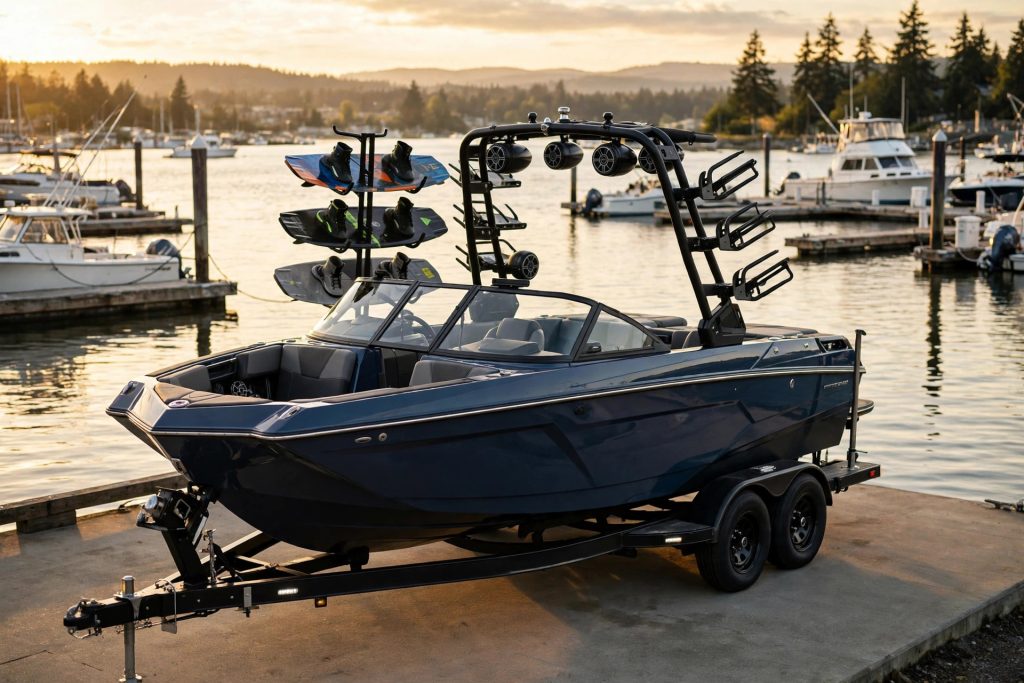
Do not finance for the longest term just to get the lowest payment. On a $120,000 loan at 8 percent, stretching from 10 years to 20 years drops the payment to about $1,004 a month but adds tens of thousands in interest. Do not skip the survey on a used wake boat, and do not forget insurance, storage, and winterization in your budget. Finally, do not let a dealer roll the boat price and the loan into one monthly payment figure. When price and financing blend together, you cannot tell which one moved, and that is how buyers overpay.
Financing a wakeboard boat is straightforward once you know the numbers: get pre-approved, compare lenders, keep the term as short as you can afford, and budget for the full cost of ownership.

Michael Carter is a financial research writer specializing in vehicle financing, loan calculations, interest rates, and consumer budgeting. He creates practical, easy-to-understand resources that help readers make more informed financing decisions.