New vs Used Boat: Which Is Better in 2026?
Buying a boat can be exciting, but choosing between new and used can quickly become confusing. A new boat offers warranty protection and modern features, while a used boat may provide better value with a lower purchase price. This guide compares price, depreciation, maintenance, warranty, financing, and resale value to help you choose the option that best fits your budget and boating goals.
In 2026, compare the actual selling price rather than MSRP alone. Dealer discounts, inventory incentives, financing rates, and the condition of comparable used boats can change which option provides better value.
Decision rule: Compare the new-boat premium against depreciation, warranty value, expected maintenance, financing cost, and resale potential before choosing.
The better choice is not simply the boat with the lower purchase price. Consider depreciation, maintenance, financing, warranty, resale value, and total ownership cost before deciding.
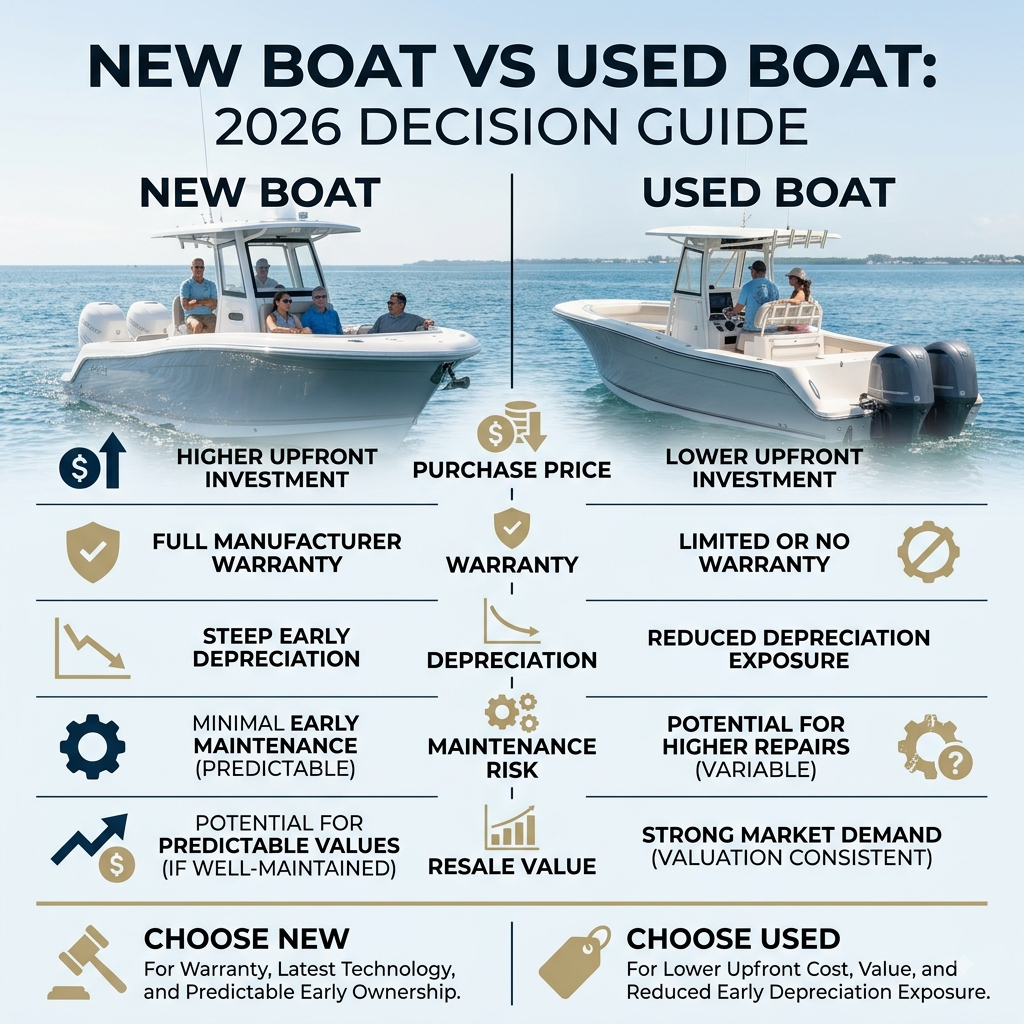
| Factor | New Boat | Used Boat |
|---|---|---|
| Purchase Price | Higher | Lower |
| Warranty | Usually strongest | May be limited or expired |
| Early Depreciation | Higher | Usually lower |
| Condition Risk | Lower | Higher |
| Customization | Highest | Limited |
| Technology | Latest | Varies by age |
| Maintenance | Usually lower initially | Depends on history |
| Value per Dollar | Lower initially | Often higher |
Best for new: Buyers who prioritize warranty protection, current technology, customization, and predictable early ownership.
Best for used: Buyers who prioritize purchase value, lower upfront costs, and are comfortable evaluating condition and maintenance history.Choosing between a new and used boat is only one part of the buying process. Our boat buying guide covers the broader steps, costs, inspections, and financing considerations you should understand before making a purchase.
New vs Used Boat Cost: What Will You Really Pay?
The real cost of a boat includes more than its purchase price. Compare purchase price, financing interest, depreciation, insurance, maintenance, storage, fuel, registration, and expected resale value before deciding.
A used boat with a lower sticker price can still become more expensive if it requires major repairs or carries a higher financing cost. Conversely, a discounted new boat with warranty coverage may narrow the effective cost difference.
Practical rule: Compare the total estimated ownership cost, not just the amount shown on the sales listing.
For example, a $60,000 used boat is not automatically cheaper to own than a $75,000 new boat. If the used boat needs major engine work, electronics, or deferred maintenance, the initial $15,000 saving can shrink quickly.
A buyer should compare:
- Purchase price
- Loan interest
- Expected depreciation
- Insurance
- Maintenance and repairs
- Storage and fuel
- Expected resale value
Practical insight: A used boat can offer better value when its condition, service history, and remaining useful life justify the price difference.
New vs Used Boat: Warranty, Condition & Maintenance
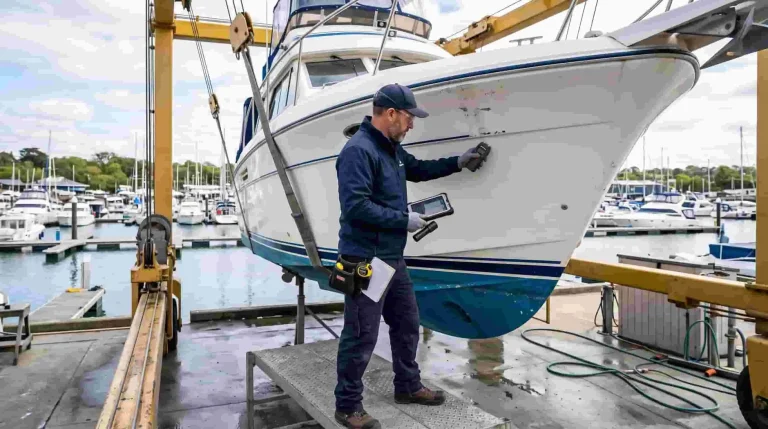
A used boat should be evaluated by condition, engine hours, service records, repair history, and remaining equipment life, not age alone. A marine survey and sea trial can reveal structural or mechanical problems before purchase.
Decision rule: If a used boat has incomplete service records, unusual engine hours, visible defects, or significant deferred maintenance, price the expected repairs before comparing it with a new boat.
The age of a boat alone does not determine its condition. A well-maintained older boat with complete service records can be a better purchase than a newer boat with neglected maintenance.
Key rule: For a used boat, evaluate condition and maintenance history alongside age and price.
Who Should Buy New and Who Should Buy Used?
Choose a New Boat If:
- You want manufacturer warranty protection.
- You prefer the latest technology.
- You want specific customization options.
- You have a higher purchase budget.
- You want fewer unknown maintenance issues.
- You prioritize predictable early ownership.
Choose a Used Boat If:
- You want to reduce the upfront purchase price.
- You want to limit exposure to early depreciation.
- You can evaluate mechanical and structural condition.
- You are comfortable buying through a dealer or private seller.
- You prioritize value over the newest features.
A first-time buyer with limited mechanical knowledge may value the predictability of a new boat. An experienced buyer who can assess condition may find a carefully maintained used boat offers substantially more value.
Decision rule: Buy new when warranty, predictability, and current features justify the premium. Buy used when condition, price, and maintenance history create a stronger overall value.
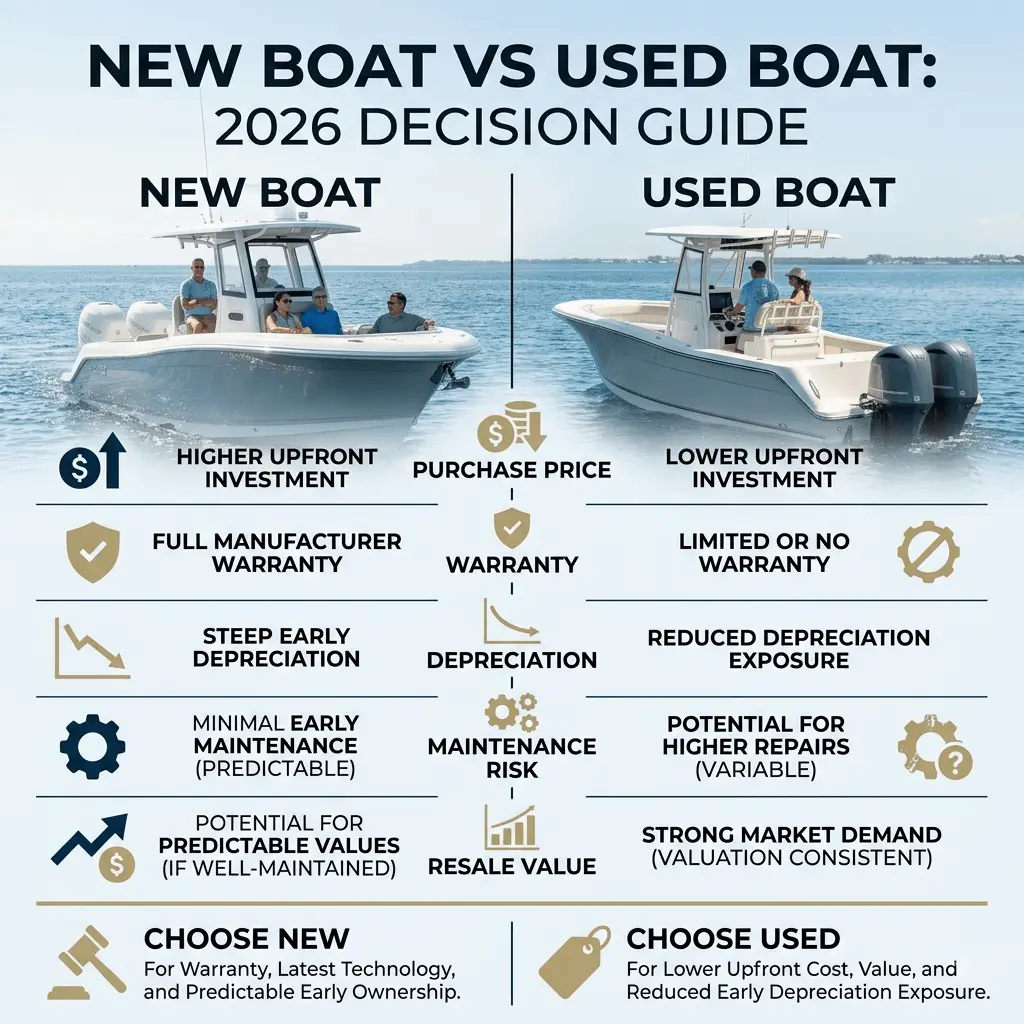
New vs Used Boat Decision Matrix
| If Your Priority Is… | Choose |
|---|---|
| Lowest upfront cost | Used |
| Factory warranty | New |
| Latest technology | New |
| Lower early depreciation exposure | Used |
| Maximum customization | New |
| Predictable early maintenance | New |
| Maximum value for a fixed budget | Used |
| Minimal condition uncertainty | New |
| Experienced buyer seeking value | Used |
Bottom line: Choose new when warranty, predictability, and current features justify the premium. Choose used when condition, price, maintenance history, and remaining useful life create stronger overall value.Looking for more help before making your purchase? Explore our boat buying resources for calculators, financing guides, ownership-cost tools, and practical advice for U.S. boat buyers.
Before deciding, compare your preferred boats using the same criteria: purchase price, financing cost, warranty, condition, maintenance, depreciation, and expected resale value. A used boat should also be evaluated through appropriate inspection and survey procedures.
The right choice ultimately depends on the trade-off you are willing to make between price, risk, features, and ownership costs.
Frequently Asked Questions
Is a new boat always better than a used boat?
No. A new boat provides stronger warranty protection and newer equipment, but a used boat can offer substantially better value. The better choice depends on condition, price, maintenance history, financing, and your risk tolerance.
How much can I save by buying a used boat?
Savings vary by boat model, age, condition, equipment, and market demand. Compare the used purchase price with depreciation, repairs, upgrades, financing, and expected resale value rather than assuming every used boat is automatically cheaper.
Is a used boat more expensive to maintain?
It can be, particularly when maintenance has been deferred. Engine hours, service history, age, condition, and previous repairs are stronger indicators of maintenance risk than age alone.
Do new boats depreciate faster?
New boats generally face greater early depreciation because the buyer pays for the new-boat premium. A used boat has already absorbed some depreciation, although actual resale values vary by model, condition, market demand, and equipment.
Do I need a marine survey for a used boat?
A marine survey can help identify structural, mechanical, and safety issues before purchase. It is especially useful for higher-value boats or purchases where the condition and maintenance history are uncertain.
Which is better for a first-time boat buyer?
A new boat may be easier for a first-time buyer who values warranty protection and predictable ownership. A well-maintained used boat can also be an excellent choice when the buyer obtains a proper inspection and understands its maintenance needs.
Is a 2–5-year-old boat a good alternative to buying new?
A 2–5-year-old boat can offer a useful middle ground between new-boat pricing and older-boat maintenance risk. It may have absorbed some initial depreciation while retaining relatively modern equipment. Evaluate its warranty, engine hours, service records, condition, and asking price before deciding.
Can a discounted new boat be a better deal than a used boat?
Yes. A heavily discounted new boat can become more competitive when its price approaches comparable used models. Compare the final purchase price, financing cost, warranty coverage, expected maintenance, depreciation, and resale value rather than assuming used is always cheaper.

Michael Carter is a financial research writer specializing in vehicle financing, loan calculations, interest rates, and consumer budgeting. He creates practical, easy-to-understand resources that help readers make more informed financing decisions.