Bass Boats: Complete Guide to Types, Features, Prices
Bass Boats can be confusing to choose when prices, sizes, hull materials, engines, and fishing features vary so widely. This guide breaks down the main bass boat types, key features, price ranges, ownership costs, and buying considerations so you can quickly identify the right boat for your fishing style and budget.
Choosing the wrong model can lead to unnecessary costs, poor towing compatibility, or features you rarely use. By comparing aluminum vs. fiberglass, new vs. used, boat size, engine performance, and total ownership costs, you can make a more confident purchase without paying for capabilities you do not need.
What Are Bass Boats?
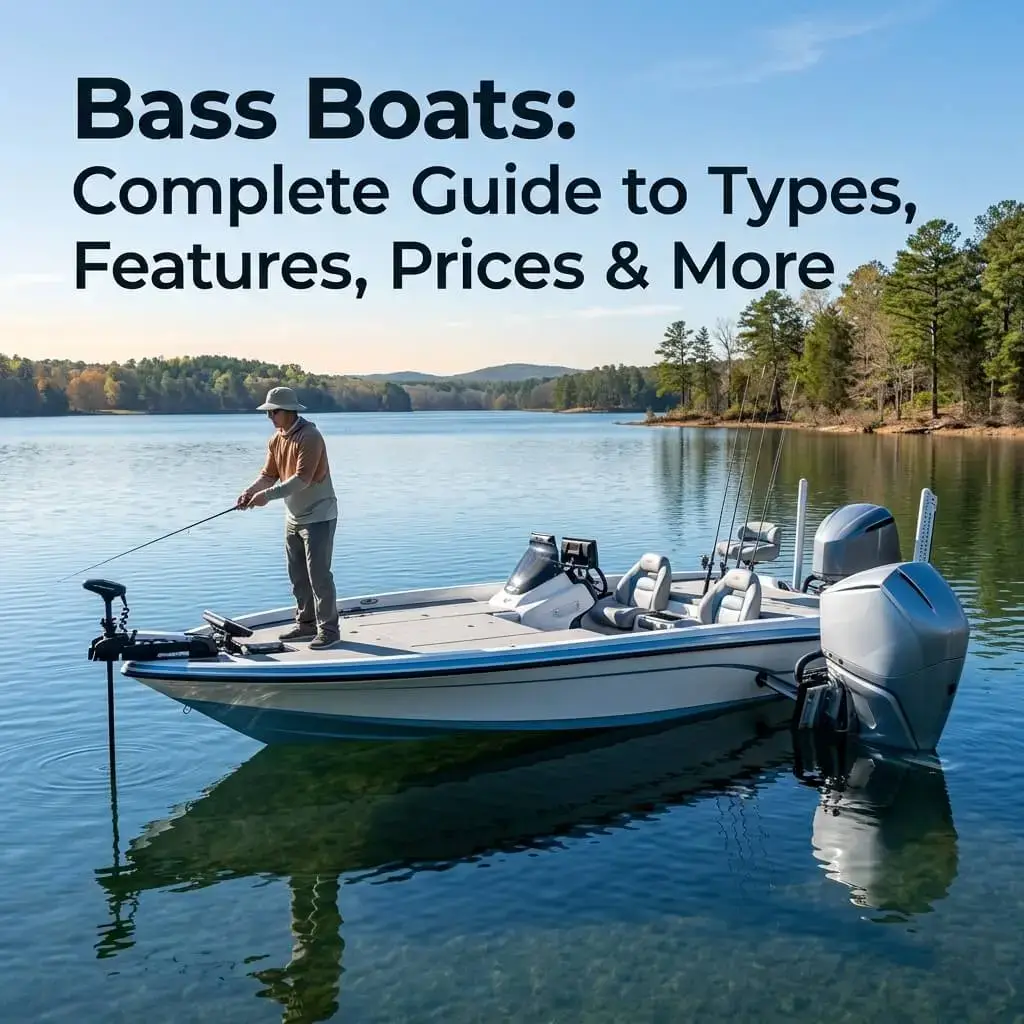
Bass boats are specialized freshwater fishing boats built for bass anglers. Their low-profile hulls, casting decks, livewells, fishing storage, and trolling motors prioritize fishability over general-purpose boating. Most models carry two or three anglers, although larger boats can accommodate more.
Unlike multipurpose fishing boats, bass boats are optimized for casting, shallow-water access, fast movement between fishing spots, and tournament-style angling.
Types of Bass Boats
Bass boats mainly differ by hull material, fishing purpose, size, and performance.
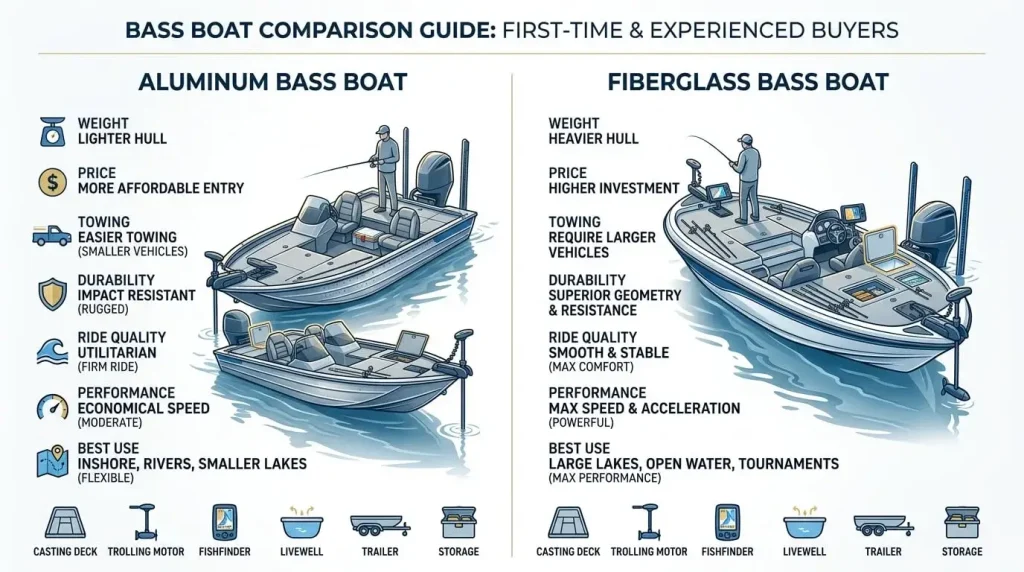
- Aluminum bass boats: Lightweight, easier to tow, and generally more affordable.
- Fiberglass bass boats: Heavier, often faster, and favored for refined ride quality and tournament performance.
- Tournament bass boats: Larger, faster, and equipped for serious competitive fishing.
- Recreational bass boats: Focus on affordability and practical freshwater fishing.
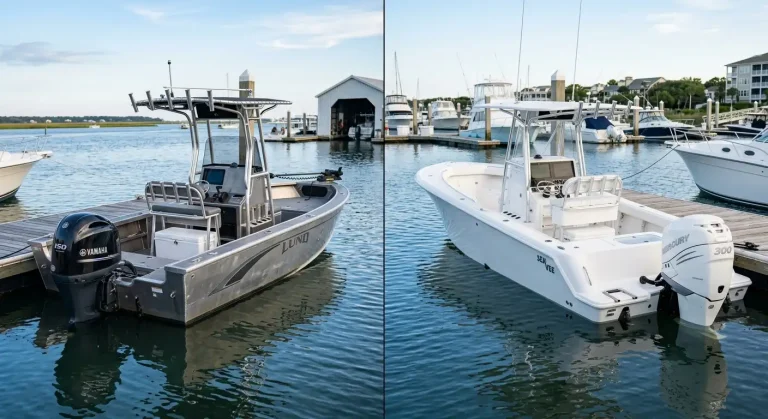
The right type depends on your water, fishing style, towing vehicle, and budget.Bass boats are built for focused bass fishing, while center console boats offer more open space and versatility for different fishing and boating activities. The better choice depends on how you plan to use your boat and the type of water you frequent.
Key Features of a Bass Boat
A good bass boat combines fishing-specific equipment with performance features.
- Casting decks: Provide stable standing areas for casting.
- Livewells: Keep caught fish alive during fishing or tournaments.
- Trolling motor: Enables quiet, precise movement around fishing structure.
- Fishfinder and GPS: Help locate fish, structure, depth, and productive areas.
- Rod and tackle storage: Keeps fishing equipment organized and accessible.
- Outboard motor: Provides speed for traveling between fishing locations.
Prioritize features you will actually use rather than paying for every available upgrade.
Aluminum vs Fiberglass Bass Boats
| Factor | Aluminum | Fiberglass |
|---|---|---|
| Weight | Lighter | Heavier |
| Price | Usually lower | Usually higher |
| Towing | Easier | Requires more capacity |
| Durability | Good for rugged use | Strong but more vulnerable to certain impacts |
| Performance | Practical | Often better for high-performance applications |
| Best For | Beginners, smaller waters, budget buyers | Tournament and performance anglers |
Choose aluminum when affordability, towing, and rugged practicality matter most. Choose fiberglass when ride quality, performance, and tournament-oriented features justify the higher cost.
How Much Do Bass Boats Cost?
Bass boat prices vary by hull material, size, engine, electronics, condition, and equipment. A practical market framework is:
| Bass Boat Category | Typical Budget | Best For |
|---|---|---|
| Entry-level aluminum | $10,000–$30,000 | Beginners and smaller waters |
| Mid-range aluminum/fiberglass | $30,000–$50,000 | Recreational anglers |
| Mid-range fiberglass | $45,000–$75,000 | Serious anglers |
| Tournament fiberglass | $70,000–$100,000+ | Competitive fishing |
| Used bass boats | $15,000–$60,000+ | Value-focused buyers |
These are general market ranges, not fixed prices. A well-equipped used premium boat can cost less than a new entry-level fiberglass model. Current market guides show similarly broad pricing, while Boat Trader reports an even wider range across listings.
The important gap is not simply knowing the price range. Compare the complete rig boat, engine, trailer, electronics, trolling motor, and included equipment before deciding which deal is actually cheaper.
New vs Used Bass Boats: Which Is Better?
New bass boats offer current technology, factory warranty, and predictable condition but usually require a larger initial investment. Used bass boats can provide more equipment for your budget but require closer inspection of the hull, engine, electronics, trailer, and maintenance history.
| Choose New If | Choose Used If |
|---|---|
| You want warranty coverage | Lower purchase price matters |
| You want current technology | You can inspect condition |
| You prefer predictable ownership | You want more features per dollar |
A well-maintained used tournament boat can sometimes offer more capability than a new entry-level model at a similar purchase price.
If you’re planning to finance a boat, Boat Loan Calculator can help you estimate monthly payments based on the loan amount, APR, term, and down payment. Use it to compare financing scenarios and understand your potential costs before applying for a loan.
What Size Bass Boat Should You Buy?
Choose bass boat size based on where you fish, how many people you carry, your tow vehicle, and your storage space. Most bass boats fall roughly within the 16–26-foot range, although common dedicated models are often around 17–22 feet.
| Your Situation | Practical Starting Point |
|---|---|
| Solo or small-lake fishing | Smaller bass boat |
| Beginner with limited towing capacity | Lightweight aluminum |
| Two anglers on larger lakes | Mid-size model |
| Tournament fishing | Larger fiberglass model |
| Rougher water and long runs | Wider, heavier fiberglass |
Information Gain: Do not buy a larger boat simply for speed. Match length and beam to your fishing water, tow vehicle, storage, and actual passenger needs.
Bass Boat Engine and Performance
Most bass boats use an outboard motor for high-speed travel and a trolling motor for quiet positioning while fishing. Horsepower should match the hull’s rated capacity, intended speed, load, and water conditions.
Do not choose an engine based on horsepower alone. A heavier boat carrying batteries, fuel, anglers, and equipment needs a setup that maintains practical performance under real operating conditions.
What Does It Cost to Own a Bass Boat?
The purchase price is only the starting cost. Budget for fuel, insurance, registration, maintenance, batteries, repairs, trailer service, storage, and fishing equipment.
A cheaper used boat can become more expensive if it needs immediate engine, trailer, electrical, or electronics repairs. Conversely, a higher-priced boat with better condition may reduce near-term repair risk. Current buying guides also emphasize insurance, fuel, maintenance, storage, and trailer costs when evaluating total ownership.
Decision Rule: Compare purchase price + expected first-year repairs + recurring ownership costs, not the sticker price alone.
How to Choose the Right Bass Boat
Use this decision framework:
| Your Priority | Better Starting Point |
|---|---|
| Lowest overall entry cost | Aluminum |
| Solo or small-lake fishing | Compact bass boat |
| Tournament fishing | Fiberglass performance model |
| Easy towing | Lightweight aluminum |
| Maximum performance | Larger fiberglass model |
| More equipment per dollar | Carefully inspected used boat |
Start with your fishing style and budget, then select size, hull material, engine, electronics, and storage. This prevents expensive features from determining your purchase before your actual needs do.
Common Bass Boat Buying Mistakes
Avoid these common mistakes:
- Choosing horsepower without checking the hull rating.
- Ignoring the towing capacity of your vehicle.
- Comparing boat prices without comparing included equipment.
- Buying a large boat for water that does not require it.
- Prioritizing electronics over hull and engine condition.
- Ignoring storage, insurance, maintenance, and fuel costs.
- Buying a used boat without inspecting the engine and trailer.
A wider beam can improve room, balance, and stability, while hull weight affects towing and loaded performance. These specifications deserve attention alongside length and horsepower.
Bass Boat Buying Checklist
Before buying, verify:
- Hull condition and construction
- Engine condition and service history
- Trolling motor operation
- Fishfinder and GPS functionality
- Livewell and pumps
- Batteries and electrical system
- Trailer condition and tires
- Included accessories
- Warranty or transferable coverage
- Registration and ownership documents
- Total ownership cost
The best bass boat is not necessarily the fastest or most expensive. It is the boat whose size, construction, equipment, performance, and ownership cost match how you actually fish.
Frequently Asked Questions About Bass Boats
Are bass boats good for beginners?
Yes. Smaller aluminum models can provide a practical entry point because they are generally lighter, easier to tow, and less expensive.
How much does a bass boat cost?
Prices range from roughly $9,000 for some used or basic models to more than $100,000 for premium performance boats.
Are aluminum or fiberglass bass boats better?
Neither is universally better. Aluminum favors affordability and easy towing, while fiberglass generally suits performance-focused anglers.
How long do bass boats last?
Service life depends heavily on hull construction, engine maintenance, storage, usage, and repairs. A well-maintained boat can remain useful for many years.
What size bass boat should I buy?
Choose based on your fishing waters, passenger needs, towing capacity, storage, and budget rather than length alone.
Can I use a bass boat for other types of fishing?
Yes, but bass boats are highly specialized. They work best for freshwater fishing that benefits from casting decks, fishing storage, livewells, and trolling motors. They are less versatile than general-purpose or multi-species fishing boats.
What vehicle can tow a bass boat?
The tow vehicle must be rated for the loaded trailer weight, not just the boat’s dry weight. Include the boat, engine, fuel, batteries, equipment, and trailer when checking towing capacity.

Michael Carter is a financial research writer specializing in vehicle financing, loan calculations, interest rates, and consumer budgeting. He creates practical, easy-to-understand resources that help readers make more informed financing decisions.