Offshore Fishing Boats: How to Choose the Right Boat
Offshore Fishing Boats are difficult to choose when every model seems to promise stability, performance, range, and fishing capability. The wrong choice can leave you with limited fuel range, an uncomfortable ride in rough water, insufficient deck space, or equipment that does not match your fishing style. Simply choosing the largest or most powerful boat does not guarantee the right fit.Before comparing hulls and layouts, understand the main categories of fishing watercraft and how each is designed for different environments.
The better approach is to match the boat to where you fish, how far you travel, target species, crew size, sea conditions, and trip duration. This guide breaks down offshore boat types, hull designs, fishing features, size, range, and power systems so you can compare your options and choose a boat that fits both your fishing needs and budget.
What Are Offshore Fishing Boats?
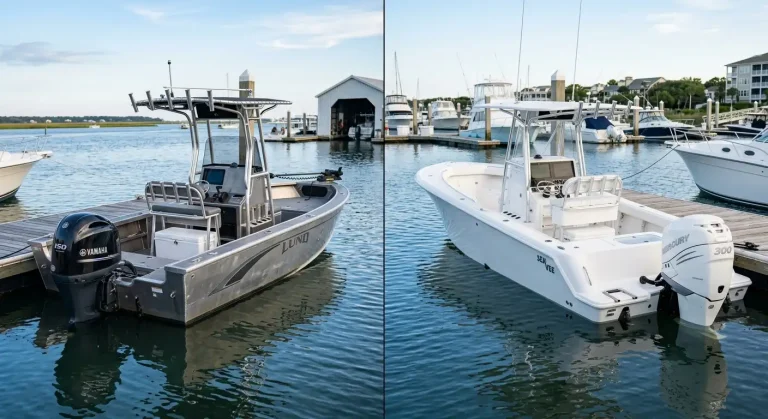
Offshore fishing boats are boats configured for fishing beyond protected inshore waters, where greater range, seaworthiness, fishing space, and weather protection can become important. Common configurations include center consoles, walkarounds, express fishing boats, convertibles, and offshore catamarans.
Unlike a basic inshore fishing boat, an offshore setup may need greater fuel capacity, higher freeboard, a more substantial hull, marine electronics, larger fish boxes, livewells, and additional protection from spray and weather.
“Offshore” is not a standardized boat size or single hull type. A boat’s offshore capability depends on its hull design, dimensions, equipment, propulsion, operating conditions, and intended range.
What Types of Offshore Fishing Boats Are Available?
Different configurations solve different offshore fishing problems.
| Boat configuration | Best suited for | Main advantage |
|---|---|---|
| Center console | Versatile offshore fishing | Open deck and 360-degree fishing access |
| Walkaround | Fishing with weather protection | Side access plus enclosed forward space |
| Express fishing boat | Offshore trips with added comfort | Protected helm and cabin amenities |
| Convertible sportfisher | Extended offshore and big-game fishing | Large cockpit, accommodation, and offshore equipment |
| Catamaran | Offshore fishing and stability-focused use | Multihull design with a wide platform |
The important distinction is not which type is universally best. It is which configuration matches the fishing mission.
How Does Hull Design Affect Offshore Fishing?
Hull design directly affects how an offshore boat behaves in waves, chop, and changing sea conditions.
A deep-V monohull uses a pronounced V-shaped bottom to improve ride characteristics in rougher water. A stepped monohull uses steps in the hull bottom to alter water flow and can be designed around performance and efficiency. Catamarans use two hulls and offer a different combination of stability, space, and ride characteristics.
Deadrise is another important specification. It describes the angle of the hull bottom and helps explain differences in ride and stability, but it should not be treated as a standalone measure of offshore capability.
When comparing boats, evaluate the entire combination of hull design, freeboard, size, weight, construction, and expected sea conditions rather than choosing by one specification.Once you’ve shortlisted the right size and configuration, estimate your boat loan payments to see whether the purchase fits your monthly budget.
What Features Matter Most on an Offshore Fishing Boat?
The best features depend on how you fish, but several systems directly affect offshore usability:
- Livewell: Keeps live bait or caught fish in controlled water conditions.
- Fish boxes: Provide dedicated storage for larger catches.
- Rod storage and holders: Keep tackle organized and accessible.
- T-top or tower: Provides shade and can support electronics or fishing equipment.
- Outriggers: Help spread trolling lines away from the boat.
- GPS/chartplotter: Supports navigation and route planning.
- Radar: Helps identify vessels, land, and weather-related objects in appropriate conditions.
- VHF radio: Provides marine communication capability.
- Self-bailing cockpit: Helps manage water entering the fishing area.
- Higher gunwales: Provide additional separation between anglers and the water.
The useful approach is to connect each feature to your fishing method. A serious offshore trolling setup may need different equipment from a boat primarily used for reef fishing or shorter coastal trips.
How Much Boat Size and Range Do You Need?
Boat size should follow the mission, not a universal offshore number.
Consider these five variables:
- Distance offshore: Longer trips increase the importance of fuel capacity and range.
- Crew size: More anglers require additional seating, deck space, storage, and facilities.
- Sea conditions: More demanding conditions require an appropriate hull, freeboard, and overall boat design.
- Fishing method: Trolling, bottom fishing, and big-game fishing place different demands on cockpit space and equipment.
- Trip duration: Multi-day trips may require a cabin, berth, galley, head, and additional storage.
Range also needs a margin for changing conditions and operational requirements. Do not calculate an offshore trip based only on the distance from shore to the fishing location.
What Power System Is Best for Offshore Fishing?
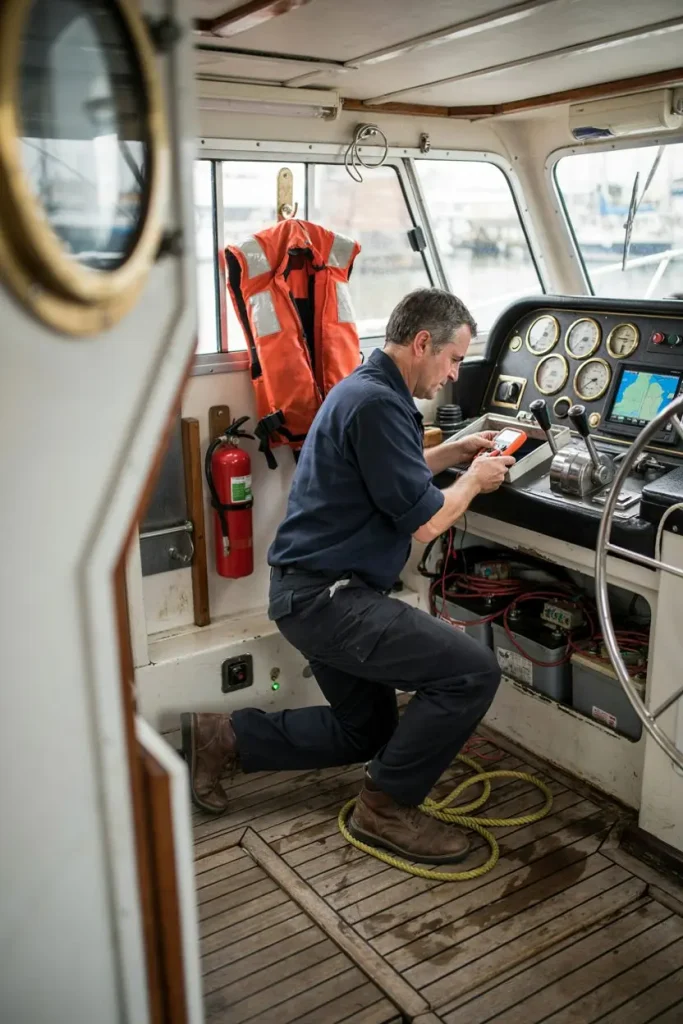
Offshore boats commonly use outboard or inboard propulsion, with some larger fishing boats using multiple engines.
Outboards can provide strong performance and straightforward access for service. Multiple outboards can also provide additional propulsion redundancy, although they increase purchase, fuel, and maintenance considerations.
The correct power system depends on the boat’s size, hull, intended load, operating range, and manufacturer specifications. Engine count alone does not determine offshore capability.
How Do You Choose an Offshore Fishing Boat?
Use this sequence before comparing brands or models:
1. Define the fishing environment.
Identify whether you will fish nearshore, offshore, or farther into bluewater conditions.
2. Define the fishing mission.
Determine target species, fishing method, trip frequency, and typical distance offshore.
3. Determine crew requirements.
Account for anglers, passengers, seating, deck space, storage, and movement around the cockpit.
4. Match the hull to conditions.
Compare deep-V monohulls, stepped hulls, and catamarans according to the water conditions you expect.
5. Calculate the required range.
Consider fuel capacity, trip distance, expected conditions, and an appropriate reserve.
6. Match equipment to fishing style.
Prioritize livewells, fish boxes, rod storage, electronics, outriggers, and cockpit layout according to how you fish.
7. Decide whether accommodation matters.
For day trips, an open configuration may be sufficient. Extended trips can justify a walkaround, express, or convertible configuration with enclosed accommodation.
This process prevents a common mistake: choosing a boat because of its size or engine package before determining what the boat actually needs to accomplish.
Offshore Fishing Boat vs. Inshore Fishing Boat
| Factor | Offshore Fishing Boat | Inshore Fishing Boat |
|---|---|---|
| Primary environment | Offshore and bluewater conditions | Protected coastal and shallow waters |
| Range | Greater range may be required | Usually shorter trips |
| Hull requirements | More emphasis on offshore seakeeping | Often optimized for shallow or protected water |
| Freeboard | Often greater | Can be lower |
| Fuel capacity | More important for longer trips | Usually less demanding |
| Equipment | Offshore electronics and fishing systems | Inshore-focused equipment |
| Accommodation | More common on larger boats | Less common |
| Fishing mission | Offshore species and longer trips | Inshore species and shorter trips |
An offshore boat can be used for some inshore fishing, but buying a larger offshore configuration solely for short protected-water trips may add cost, size, and operating requirements that you do not need.
Is an Offshore Fishing Boat Right for You?
An offshore fishing boat makes sense when your fishing routinely takes you beyond protected waters and you need the range, hull characteristics, fishing space, equipment, and protection for those conditions.
A smaller center console may make sense for versatile offshore and inshore fishing. A walkaround or express configuration becomes more attractive when weather protection and cabin space matter. A larger convertible or sportfishing boat is more appropriate when extended offshore trips, accommodation, and serious big-game fishing are central to the mission.
Before setting a purchase budget, compare boat prices and ongoing ownership requirements alongside the boat’s specifications. Once you have an approximate purchase price, you can estimate your boat loan payments to see how the chosen configuration fits your budget.
FAQs About Offshore Fishing Boats
1. What type of boat is best for offshore fishing?
Center consoles, walkarounds, express boats, convertibles, and catamarans can all work offshore. The best choice depends on your fishing style, distance from shore, sea conditions, crew, and trip duration.
2. What hull is best for offshore fishing?
A deep-V hull is a common choice for offshore fishing because it is designed to handle waves and open-water conditions. Stepped hulls and catamarans can also suit specific performance and stability requirements.
3. How big should an offshore fishing boat be?
Choose the size based on your typical crew, fishing distance, sea conditions, range requirements, and whether you take day or overnight trips. Bigger is not automatically better if it exceeds your actual needs.
4. What features should an offshore fishing boat have?
Important features include livewells, fish boxes, rod storage, higher gunwales, marine electronics, VHF radio, adequate fuel capacity, and reliable propulsion. The right equipment depends on your fishing method and target species.

Michael Carter is a financial research writer specializing in vehicle financing, loan calculations, interest rates, and consumer budgeting. He creates practical, easy-to-understand resources that help readers make more informed financing decisions.