Can Foreigners Get a Boat Loan in the US?
If you live outside the United States but dream of buying a boat here, you are probably wondering whether US lenders will even talk to you. The short answer: yes, foreigners and non-residents can get a boat loan in the US. The longer answer is that you will face tighter requirements than a US citizen, fewer lenders to choose from, and a bigger down payment. Here is exactly how it works and how to give yourself the best shot at approval.
The Basic Rule: Residency Is Not a Dealbreaker
Unlike some types of consumer credit, there is no federal law that says boat lenders must lend only to US citizens or permanent residents. Marine lenders are private businesses, and each one sets its own eligibility rules. That is why experiences vary so much: one lender may decline your application outright while another happily structures a loan around you.
What every lender cares about is risk. A borrower with no US credit history, no Social Security number, and assets in another country is harder to underwrite and harder to collect from if payments stop. So instead of a flat “no,” most lenders respond with conditions: more money down, a higher rate, and more documentation.
Who Can and Cannot Apply
Some mainstream lenders draw a hard line. For example, SoFi’s personal-loan program, which many people use for boat purchases, requires US citizenship, permanent residency, or an eligible visa, plus a credit score around 680 or higher. Discover’s personal loans similarly require US citizenship or permanent residency. If you are a pure non-resident with no US immigration status, these doors are closed.
That does not mean all doors are closed. Specialist marine lenders like Essex Credit, Trident Funding, and similar boat-loan brokers evaluate applications case by case. They regularly deal with foreign executives buying a winter home in Florida, Canadians cruising the ICW, and Europeans purchasing in the Caribbean. A lender that finances boats every day is far more likely to find a structure that works than a local bank branch that writes one boat loan a year. If you take one tip from this article, make it this one: talk to a specialist marine lender, not a general bank.
What Foreign Buyers Should Expect
Approval is realistic, but the terms will look different from a standard domestic deal.
A larger down payment
Domestic boat loans commonly require 10 to 20 percent down, according to the Boat Owners Association of The United States, with higher amounts for older boats or weaker credit. As a non-resident, expect lenders to ask for 25 to 40 percent. This is the single biggest adjustment most foreign buyers face. The larger down payment reduces the lender’s exposure and compensates for the lack of a domestic credit file. Plan your budget around at least a third of the purchase price in cash.
Proof of identity and legal presence
You will need a valid passport. If you hold any US visa, even a tourist visa, bring it, because lenders want to understand your legal basis for being here. You will not have a Social Security number, and that is fine; lenders that work with foreign buyers underwrite around it. Know what lenders typically ask for before you start your application so nothing slows you down.
Income and asset documentation
With no US credit history to score, lenders shift their focus to what they can verify: your income, your assets, and your cash reserves. Expect to provide recent pay stubs or an employer letter, tax returns from your home country, and bank statements showing liquid assets. Foreign-national lending in other areas, like US real estate, commonly requires six months or more of payment reserves in the bank, and marine lenders think the same way. Having a US bank account already open before you apply is a major plus. It shows the lender you have a payment channel in place and simplifies the closing.
A higher interest rate
Rates for foreign-national borrowers usually run higher than for domestic ones. Marine lending does not publish a standard foreign-buyer premium, but you should assume your rate will be above what a comparable US buyer pays. Run the numbers with a higher rate so the payment still fits your budget, and remember that refinancing later may be an option once you have built US credit history.
Boat size and documentation limits
Ownership rules for documentation require US citizenship for individual owners, so a foreign buyer may need to title the boat at the state level instead. That is completely normal and legal; it just means the lender structures the lien differently.
How to Strengthen Your Application
The playbook for a foreign buyer is simple: remove every source of doubt you can control.
Get pre-approved before you shop. Pre-approval tells you exactly how much a lender will commit to and on what terms, so you are not negotiating with a seller on a guess. It also signals to the seller that you are a serious buyer, which matters because sellers sometimes worry that foreign buyers will complicate the closing.
Gather your documents early. Having these ready, with translations if anything is not in English, speeds the process and looks professional.
Bring a bigger down payment than the minimum. If the lender asks for 25 percent and you can put down 35, your application gets stronger and your monthly payment gets smaller. Down payment size is the fastest way to offset thin credit.
Consider a US-based co-borrower. If you have a trusted US citizen or resident partner, adding them as a co-borrower can transform the application. Their credit history and Social Security number give the lender the familiar underwriting profile it wants. A co-signer works differently, so understand the distinction before you commit.
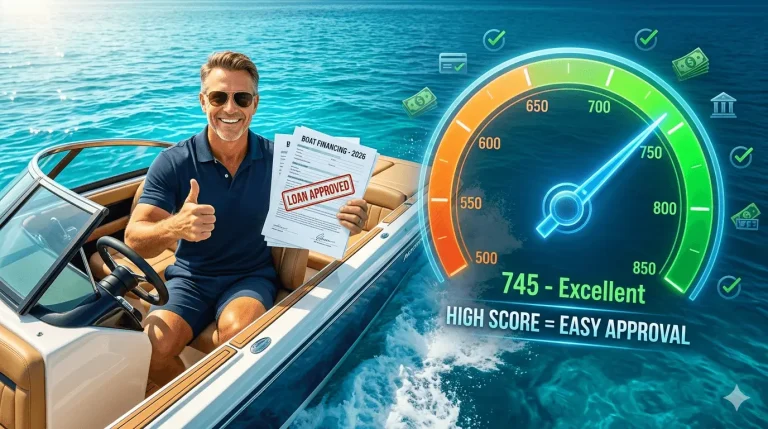
Build US credit if you have time. If your purchase is months away, even a thin US credit file helps. An ITIN, a secured credit card, and a few months of on-time payments give lenders something domestic to score. Most lenders want to see a score around 680, which takes time, but even a start is better than nothing.
A Smarter Order of Operations
If you are a non-resident planning to buy a boat in the US, do things in this order. First, confirm your down payment and the monthly payment you can afford, using a higher-than-average rate so there are no surprises. Second, open a US bank account if you can. Third, talk to two or three specialist marine lenders and compare their terms. Fourth, get pre-approved in writing. Only then should you start shopping seriously and making offers.
The Bottom Line
Foreigners absolutely can finance a boat in the US. The path is narrower than for a US citizen: expect a 25 to 40 percent down payment, extra documentation, a higher rate, and a shorter list of willing lenders. But the marine lending market includes specialists who finance international buyers every week. Come prepared with documents, cash, and a specialist lender on your side, and there is no reason a passport should keep you off the water.

Michael Carter is a financial research writer specializing in vehicle financing, loan calculations, interest rates, and consumer budgeting. He creates practical, easy-to-understand resources that help readers make more informed financing decisions.