Boat Mooring Explained: Types, Uses & Safety Tips
What Is a Boat Mooring?
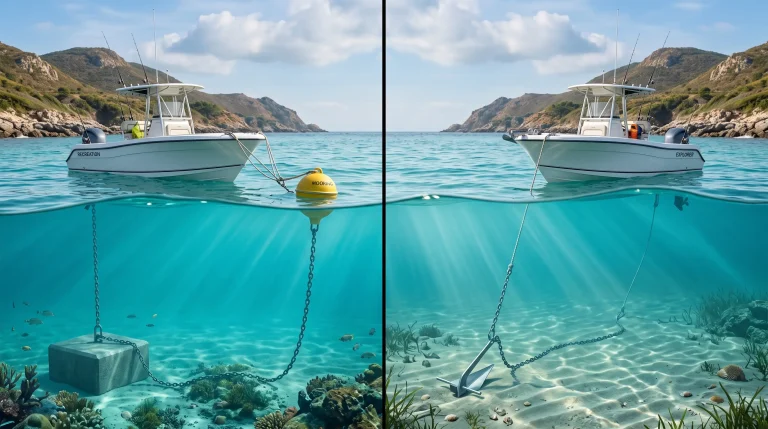
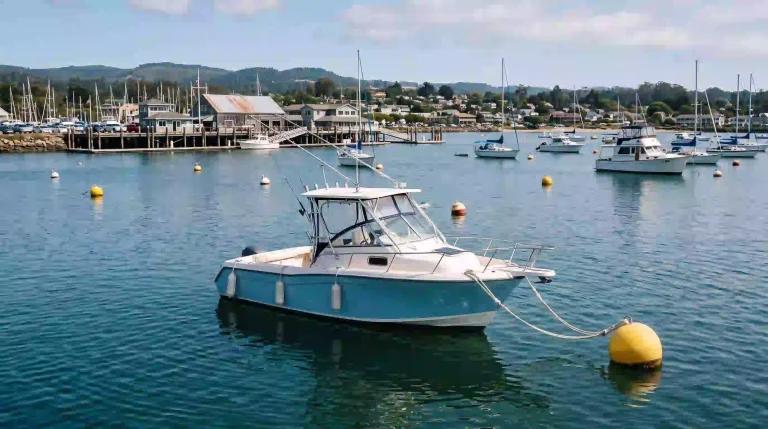
A boat mooring is a fixed or semi-permanent system that keeps a boat secured in the water without relying on an anchor carried aboard the vessel. A typical system connects the boat to an underwater holding point through components such as chain, a riser, pendant, shackle, swivel, and mooring buoy.
Unlike an onboard anchor, which can be deployed and retrieved as needed, a mooring remains installed in a specific location. A boat can remain attached to it for longer periods, making moorings common in marinas, harbors, and protected waterways.
Mooring vs. Anchoring vs. Docking
- Mooring: Secures a boat to a fixed underwater system.
- Anchoring: Uses a portable anchor deployed from the boat.
- Docking: Secures a boat alongside a fixed structure such as a pier or dock.
The right system depends on the boat, water depth, bottom conditions, wind, current, tides, and available space.
Key point: A mooring is a complete securing system, not simply a buoy or anchor.
What Are the Main Types of Boat Moorings?
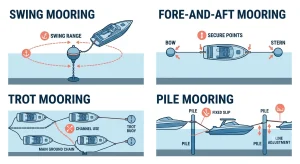
The main types of boat moorings differ by how the boat is positioned and how much movement is allowed around the holding point. Common configurations include swing moorings, fore-and-aft moorings, trot moorings, and pile moorings. The best option depends on water conditions, boat size, available space, and local requirements.
Swing Mooring
A swing mooring connects the boat to a single underwater attachment point, allowing the boat to swing around that point as wind and current change.
It is common where sufficient space exists for the boat’s swing radius. The boat naturally changes direction with environmental conditions rather than remaining fixed in one orientation.
Best for: Open or sheltered water with enough swing room.
Main limitation: Boats require adequate spacing to avoid contact with neighboring vessels.
Fore-and-Aft Mooring
A fore-and-aft mooring uses two attachment points to control the boat from both ends. This keeps the vessel more consistently aligned instead of allowing it to rotate freely around one point.
Best for: Areas where space is limited or maintaining a specific boat orientation is important.
Main limitation: It requires more equipment and careful positioning than a single-point swing mooring.
Trot Mooring
A trot mooring uses multiple mooring points arranged along a line, allowing several boats to be secured in an organized configuration.
This arrangement can make better use of limited water space than individual swing moorings.
Best for: Areas where multiple boats need organized mooring positions.
Main limitation: Installation and positioning are more complex than a simple single-point system.
Pile Mooring
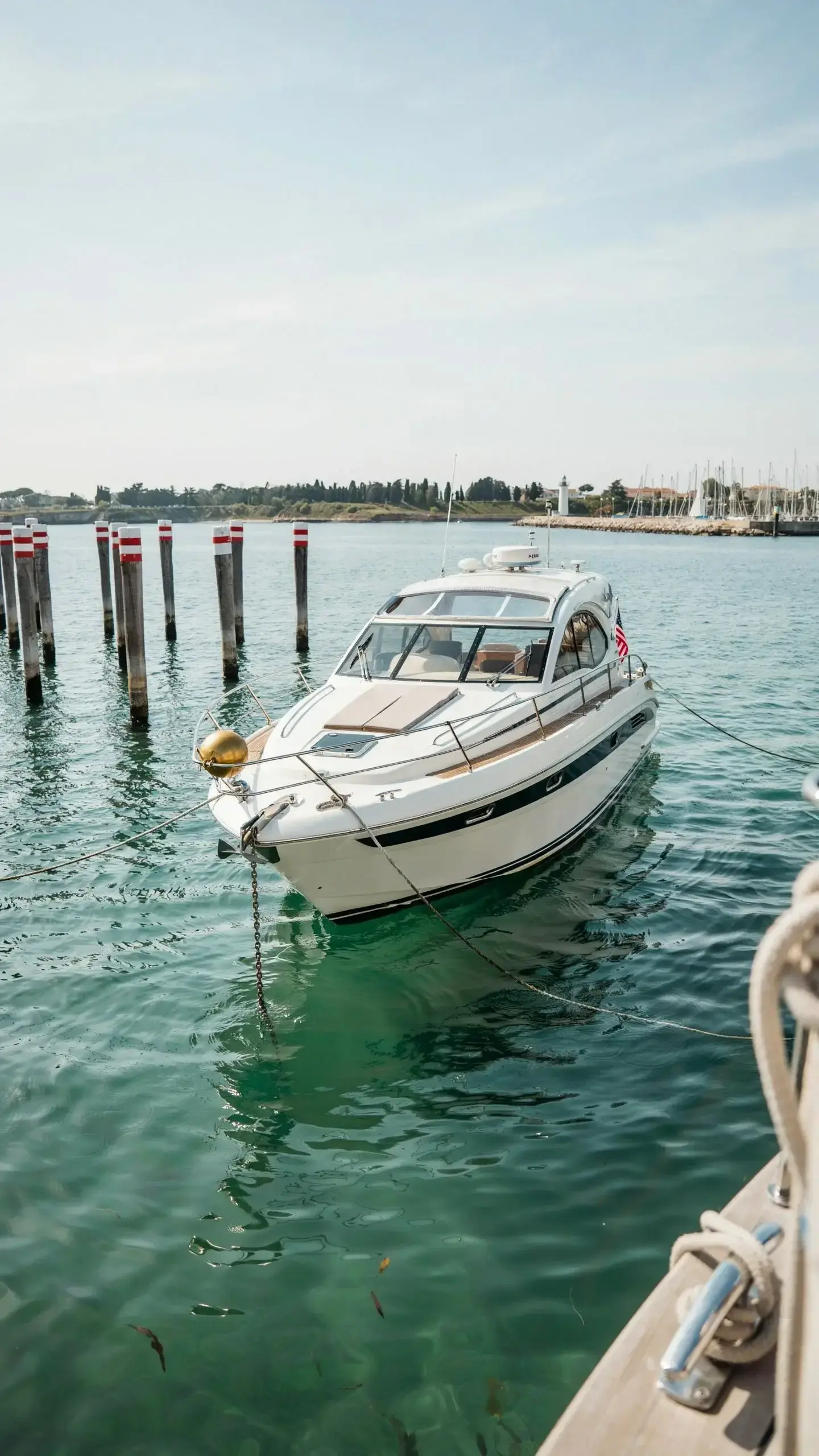
A pile mooring secures a boat using fixed piles driven into the seabed. Lines or other connections hold the boat between or alongside the piles.
Best for: Suitable waterways where permanent piles can be installed and local regulations allow them.
Main limitation: Installation depends heavily on water depth, seabed conditions, property or marina rules, and local authorization.
Key point: Mooring configurations determine how a boat is positioned and moves; they should not be confused with the type of underwater anchor holding the system.
Boat Mooring Types Compared
Choosing between mooring types becomes easier when the main differences are viewed side by side.
| Mooring Type | Boat Movement | Best For | Main Limitation |
|---|---|---|---|
| Swing Mooring | Swings around one point | Open or sheltered water | Requires swing room |
| Fore-and-Aft | Limited movement | Restricted spaces | More equipment |
| Trot Mooring | Controlled along a mooring line | Multiple boats | More complex arrangement |
| Pile Mooring | Highly controlled | Suitable shallow or managed areas | Requires suitable piles and approval |
A swing mooring generally offers a simple configuration but needs more surrounding space. A fore-and-aft or pile system provides greater positional control. A trot system is useful where several boats must share organized mooring space.
Key point: There is no universally best mooring; the right choice depends on vessel requirements, water conditions, space, and local rules.
What Types of Mooring Anchors Are Used?
A mooring anchor is the underwater holding component that keeps the mooring system attached to the seabed. Common options include mushroom anchors, pyramid anchors, helix anchors, and deadweight systems. The correct choice depends on the seabed, boat loads, environmental conditions, and required holding power.
Mushroom Anchor
A mushroom anchor uses its shape and penetration into suitable bottom material to provide holding power. It is commonly associated with permanent mooring applications.
Pyramid Anchor
A pyramid anchor uses its shape and weight to develop holding power in the seabed. It can be suitable where its characteristics match the bottom conditions and required load.
Helix Anchor
A helix anchor uses helical plates that screw into the seabed. It can provide strong holding capacity when correctly installed in suitable soil.
Deadweight Anchor
A deadweight system relies primarily on the mass of the underwater weight to resist movement. Its suitability depends on the boat, environmental loads, bottom conditions, and required holding capacity.
The strongest-looking anchor is not automatically the best choice. A mooring system must match the bottom type, water depth, boat size, wind, current, waves, and expected loads.
Key point: The mooring configuration describes how the boat is secured, while the anchor describes how the system holds to the seabed.
How Do You Choose the Right Mooring for Your Boat?
The right mooring starts with the boat and location, not with the mooring product. Consider the boat’s length and weight, water depth, bottom type, tidal range, wind, waves, current, storm exposure, available swing room, and local requirements before selecting a system.
Use this decision framework:
Boat + Location → Water Conditions → Bottom Type → Required Holding → Mooring Configuration → Local Rules
For example, a small boat in protected water may have very different requirements from a heavier boat exposed to strong current and changing tides. A swing mooring may work well where there is ample room, while a fore-and-aft or pile arrangement may be more practical where movement must be restricted.
Bottom conditions also matter because different anchors perform differently in mud, sand, clay, rock, or other seabed conditions.
Key point: Choose the complete mooring system based on the boat’s loads and the environment, rather than selecting an anchor or buoy in isolation.
Mooring Equipment, Maintenance, and Safety
A reliable mooring depends on the condition of the entire system, including the anchor, chain, riser, pendant, shackles, swivels, and buoy. Corrosion, worn connections, damaged lines, or weakened underwater components can reduce reliability even when the anchor itself remains intact.
Use a simple inspection sequence:
- Check the buoy for damage, loss of flotation, and attachment problems.
- Inspect the pendant and lines for chafing, cuts, and deterioration.
- Check shackles and swivels for corrosion, deformation, or excessive wear.
- Inspect accessible chain and connections for corrosion or damaged links.
- Check the underwater system according to local requirements or professional inspection guidance.
The mooring should also be appropriate for expected weather and environmental loads. A system that performs adequately in calm conditions may require different specifications where strong wind, waves, current, or storms are common.
Key point: Mooring safety depends on correctly selected, installed, connected, and maintained components.
Boat Mooring Rules, Permits, and Costs
Mooring requirements in the United States can vary by state, municipality, marina, harbor, waterway, and property authority. A private mooring may therefore have different requirements from a commercial or marina-managed mooring.
Before installing or using a mooring, check whether you need a mooring permit, marina approval, harbor authorization, or other local permission. Regulations can also specify where moorings may be placed and how facilities must be managed. For example, Virginia has specific regulations addressing facilities that provide boat mooring.
Mooring costs can include installation, underwater anchors, chain, pendants, buoys, permits, inspections, maintenance, and recurring marina or mooring fees. Larger boats, difficult seabed conditions, exposed locations, and more robust hardware can increase installation and maintenance costs.
Key point: Mooring legality and total cost depend on your location, system design, and environmental requirements, so verify local rules before installation.
Which Boat Mooring Is Best for You?
The best boat mooring depends on your boat size, waterway, environmental exposure, bottom conditions, available space, access needs, and budget.
| Your Situation | Potentially Suitable Approach |
|---|---|
| Open area with adequate swing room | Swing mooring |
| Limited movement required | Fore-and-aft mooring |
| Several boats in an organized area | Trot mooring |
| Fixed attachment is practical | Pile mooring |
| Strong environmental exposure | Professionally engineered system matched to conditions |
| Uncertain seabed conditions | Evaluate bottom type before selecting the anchor |
If your boat is frequently exposed to strong winds, current, waves, or storms, the system should be selected and sized using appropriate marine engineering or local mooring guidance rather than a generic rule.
For permanent installations, local authorities and qualified marine professionals can help determine whether the proposed configuration, anchor, and installation meet applicable requirements.
Key point: The best mooring is the one that safely matches your boat, location, environmental loads, and local requirements.
Frequently Asked Questions About Boat Moorings
What is the difference between a mooring and an anchor?
A mooring is a fixed or semi-permanent system installed in the water, while an anchor is portable equipment carried aboard a boat and deployed when needed. A mooring typically includes an underwater holding point, chain or riser, connection hardware, and a buoy or pendant.
Which type of boat mooring is most stable?
Stability depends on the complete system and environmental conditions. Fore-and-aft and pile configurations can restrict boat movement more than a single-point swing mooring, while the anchor and seabed determine how securely the system holds.
Can a boat swing on a mooring?
Yes. A boat on a swing mooring can rotate around its underwater attachment point as wind and current change. The required swing radius should be considered when determining spacing between neighboring boats.
How heavy should a boat mooring be?
There is no single weight that works for every boat. Required holding capacity depends on boat size, windage, current, waves, water depth, bottom type, mooring configuration, and expected environmental loads.
Is a mooring safer than anchoring?
A properly designed and maintained mooring can provide reliable long-term securing, but safety depends on correct system selection, installation, inspection, and environmental suitability. An improperly sized mooring can fail just as an inadequate anchoring system can.
Do I need a permit for a boat mooring?
Possibly. Mooring permits and installation requirements vary by location and authority. Check with the relevant marina, harbor authority, municipality, state agency, or waterway manager before installing a permanent mooring.
How often should a boat mooring be inspected?
Inspection frequency depends on the system, location, environmental exposure, and local requirements. Regular checks should look for corrosion, worn chains, damaged pendants, weakened shackles, and other signs of deterioration.
Key point: Selecting the correct mooring type is only the first step; proper installation, maintenance, and compliance determine whether the system remains reliable.

Michael Carter is a financial research writer specializing in vehicle financing, loan calculations, interest rates, and consumer budgeting. He creates practical, easy-to-understand resources that help readers make more informed financing decisions.