Types of Boat Moorings: How They Work and Which One to Choose
Types of Boat Moorings: How They Work and Which One to Choose
Choosing the right boat mooring can be confusing because different systems control boat movement, space, and holding power in different ways. A swing mooring may suit open water, while a fore-and-aft, pile, or pontoon system may work better where space and positioning are limited.
This guide explains the main types of boat moorings, how each system works, and where it is best used. By comparing movement, space requirements, and practical use cases, you can choose a mooring setup that fits your boat and local conditions.
Main Types of Boat Moorings
Different types of boat moorings control boat movement in different ways. The main difference is usually the number of attachment points and the amount of space the boat needs.
Swing Mooring
A swing mooring uses one primary attachment point, allowing the boat to turn with wind, tide, and current. It is best suited to open areas with sufficient swing room.
Fore-and-Aft Mooring
A fore-and-aft mooring secures the boat at two points, usually bow and stern. It reduces swinging and is better suited to restricted mooring areas.
Trot Mooring
A trot mooring uses an organized arrangement to position multiple boats efficiently. It is generally more suitable for managed mooring areas than a single independent boat.
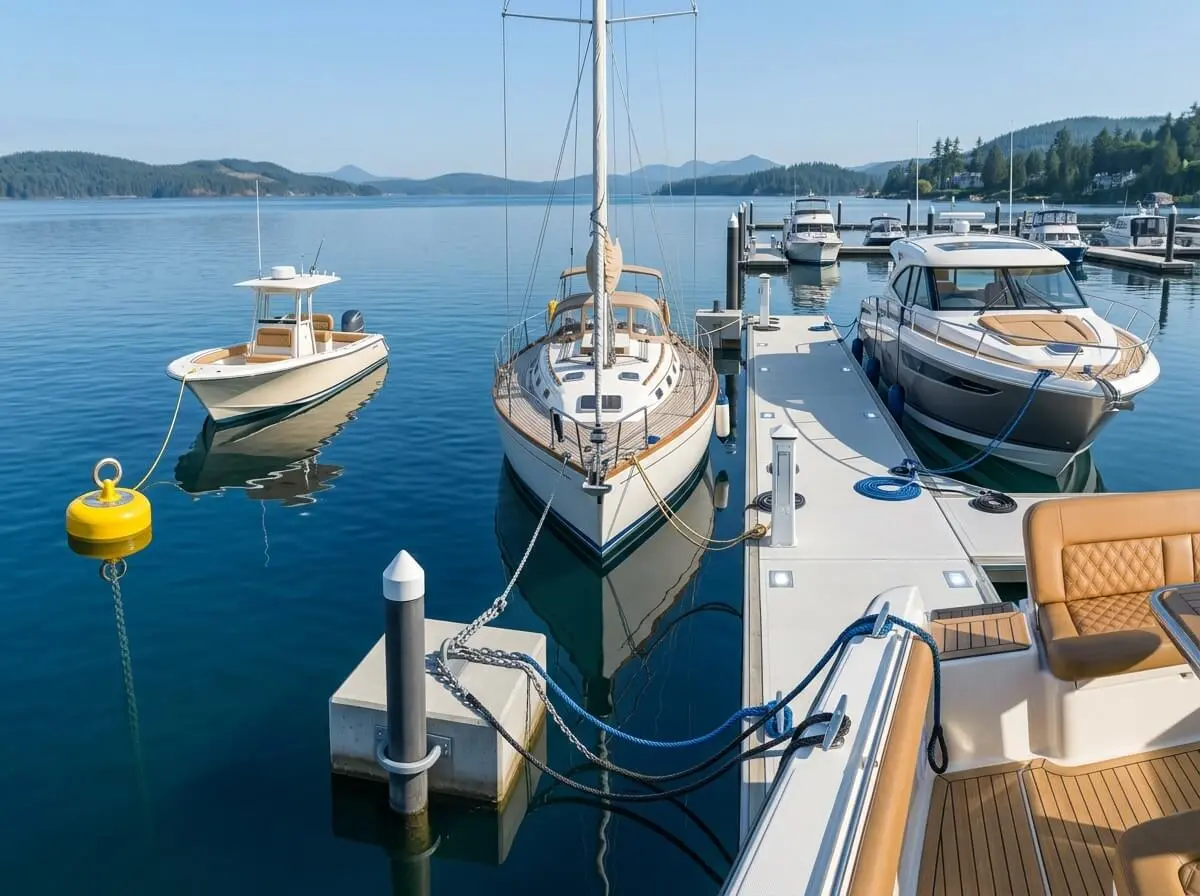
Pile and Pontoon Moorings
Pile and pontoon systems keep a boat in a more controlled position and provide easier access. They are suitable where fixed berthing is preferred over natural swinging.
Add natural internal links to Swing Mooring vs Fore-and-Aft Mooring and Marina Berthing where relevant.
How Does a Boat Mooring System Work?
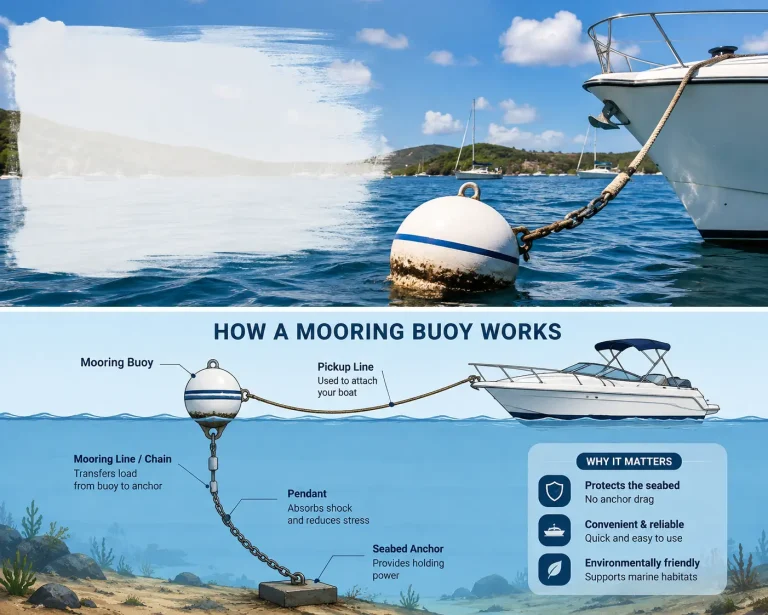
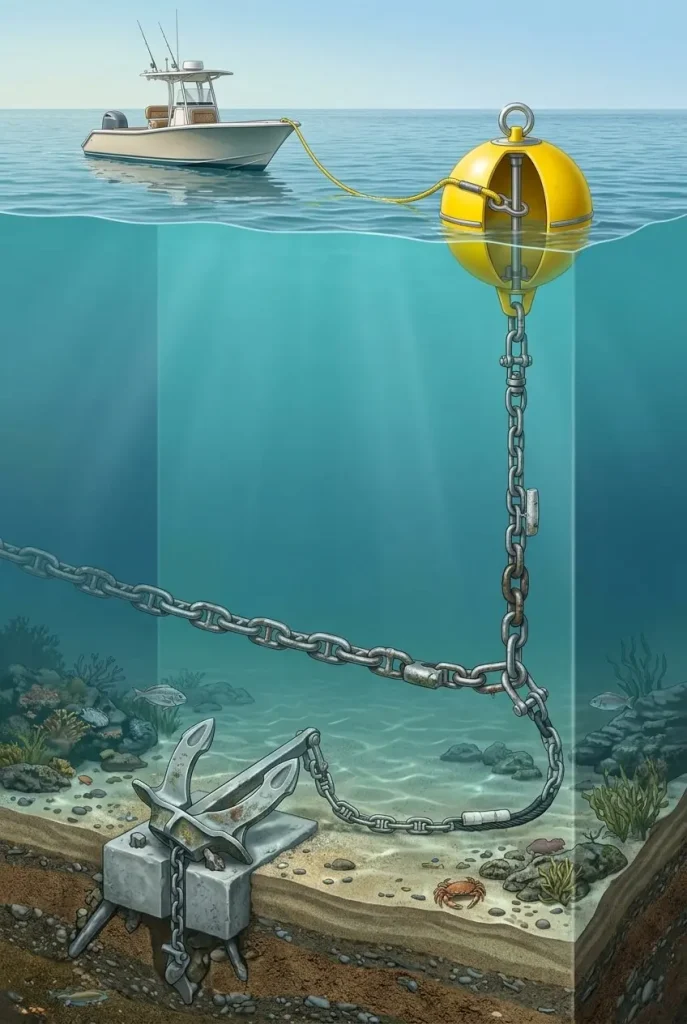
A boat mooring system transfers the boat’s load from the water surface to a secure holding point below.
Seabed → Ground anchor → Chain or rode → Riser → Mooring buoy → Pennant → Boat
The ground tackle provides holding power. The chain or rode transfers load upward, while the riser, buoy, and pennant connect the underwater system to the boat.The mooring line or pennant is a critical connection between the boat and the mooring system, and its condition directly affects overall holding security. Learn more about choosing, inspecting, and maintaining the right boat mooring lines.
The buoy marks the mooring location, but it is not the component that holds the entire load. Ground tackle, chain condition, connection hardware, and mooring lines all affect system strength.
How to Choose the Right Type of Boat Mooring
The best type of boat mooring depends on boat size, boat weight, available swing room, water depth, wind, current, tidal range, and seabed conditions.
| Mooring Type | Boat Movement | Best For | Main Limitation |
|---|---|---|---|
| Swing Mooring | High | Open water with sufficient space | Requires swing room |
| Fore-and-Aft Mooring | Low | Restricted areas | More complex setup |
| Trot Mooring | Controlled | Multiple boats | Requires an organized layout |
| Pile or Pontoon | Very Low | Fixed berthing and easy access | Requires infrastructure |
Use this simple framework when comparing options:
- Need the boat to align naturally with wind and tide? Choose a swing mooring.
- Need to reduce boat movement in limited space? Consider a fore-and-aft mooring.
- Managing several boats in one area? A trot mooring may be more space-efficient.
- Need stable access and fixed positioning? A pile or pontoon system may be more suitable.
The mooring type should also match the boat’s size and local water conditions. A system suitable for a small recreational boat may not provide sufficient holding capacity for a larger or heavier vessel.
Environmental conditions also matter. Traditional mooring systems can allow chains to contact the seabed, while some modern environmentally sensitive systems are designed to reduce seabed disturbance.
Before choosing a boat and its mooring setup, you can use a boat loan calculator to estimate your expected monthly financing payment.
Boat Mooring Safety and Maintenance Basics
A boat mooring requires regular inspection because chains, shackles, swivels, pennants, and mooring lines can weaken through corrosion, chafe, fatigue, and repeated loading.
Check visible components for fraying, corrosion, cracking, deformation, and excessive wear. Underwater ground tackle and chain should also be inspected at appropriate intervals, especially after severe weather or unusual loading.
The weakest component can determine the safety of the entire mooring system. A strong anchor cannot compensate for a worn shackle or damaged mooring line.
Frequently Asked Questions About Boat Moorings
What is the difference between anchoring and mooring?
Anchoring temporarily holds a boat using its own anchor, while mooring secures a boat to an established system such as a buoy, ground tackle, pile, or pontoon.
What is the most common type of boat mooring?
A swing mooring is commonly used in open water because it allows the boat to align naturally with wind and current.
What is a swing mooring?
A swing mooring uses one main attachment point, allowing the boat to move around the mooring as wind, tide, or current changes.
Does a boat need a mooring buoy?
Many mooring systems use a buoy to mark the location and provide access to the upper connection, but the exact setup depends on the mooring design.
Can I use a regular anchor as a permanent mooring anchor?
A regular boat anchor is generally designed for temporary use. A permanent or long-term mooring requires ground tackle and hardware selected for the boat, seabed, expected load, and local conditions.
Which mooring type requires the least swing room?
Fore-and-aft, pile, and pontoon systems generally restrict boat movement more than a swing mooring.
Natural internal links can be added to relevant Mooring, Anchoring, and Mooring System cluster pages without forcing a separate CTA.

Michael Carter is a financial research writer specializing in vehicle financing, loan calculations, interest rates, and consumer budgeting. He creates practical, easy-to-understand resources that help readers make more informed financing decisions.